Thursday, April 26, 2007

Comment of Diana Barrett,USA

We really enjoyed the discussion last evening concerning the caste system and your attempts to breach the gap between policy and actual behavior! Itwas especially interesting to meet your colleages. Your work is immensely important and we were really impressed by the degree to which you arelinking large scale human rights efforts to your work on the ground. Thanksso very much for your time and interest in meeting with us.--
Diana Barrett The Fledgling Fund,Inc.15 West 53rd Street,New York City 10019212 765 5656Helping Innovative Projects Take FlightThefledglingfund.org

Monday, April 16, 2007

Politics for Marginalized:UP Election Watch


Dear Friends,

Wishing you a very happy birth day celebration of Baba Saheb Ambedkar .The beacon of the voiceless and marginalized inspires us to follow in his foot steps.
The political discourse of our country today has been changed by an alternative voice which represents the marginalized. It is matter of time when this discourse will ring the bell of emancipation of millions. And change the languages of politics .Intervention of hundreds of civil society organizations in changing the rules of electoral politics encourages us to carry on the struggle.
With warm regards,
PVCHR


http://www.ahrchk.net/ua/mainfile.php/2005/1221/
http://www.ahrchk.net/ua/mainfile.php/2005/1209/
http://www.ahrchk.net/ua/mainfile.php/2005/1421/

Summary Note
UP Election Watch 2007

1st Phase Data
ADR PVCHR


UP Election Watch is a non-partisan body of citizens engaged in creating avenues of better participation of citizens in the Governance process. We believe that by exercising an informed choice the voters/citizens can create a momentum for an accountable and response system.

The UPEW, along with 200 CBOs/NGOs created a network of citizens across the state for this purpose.

The process has been initiated in the state by Association for Democratic Reforms (ADR) which is engaged in strengthening democracy in the country through political and electoral reforms.

A high level committee of concerned eminent citizens of UP has been formed to lead this process. This committee is convened by Sri I.C. Dwivedi, Retd DGP.

People's Vigilance committee on Human Rights (PVCHR) has become the coordinating body of the whole process. PVCHR has been involved with the cause of hunger, malnutrition, education, health and governance for the most marginalized and voiceless section of Indian society.

Many civil society organizations are part of the UPEW. For the constituencies that are going to the polls in the first phase of UP assembly elections, the contribution of network partners like Apada Niwaran Manch, Parmarth samaj santhan, Pahuj Vikas manch are worth a mention. Without the relentless efforts of such network partners' collection of affidavits would have been impossible.

Following the Supreme Court judgment on candidate's disclosure, it was the responsibility of the Civil Society to see that clean and responsive candidates are elected. Such a task could not be left to the political parties who across the board put up candidates with pending criminal records and are themselves non-transparent in financial and internal functioning matter.

UPEW collected affidavits of 785 candidates contesting in the 62 assembly seats that are going to the polls in first phase.
•131 candidates had pending criminal cases against them
•Among the major political parties BSP led the pack with 22/62 ( 35.48%) closely followed by SP 19/61(31.15%), BJP 16/54 (29.63%) and INC 15/62 (24.20%).
• 32 seats in the first phase were earlier (2002) occupied by people with serious criminal charges. This time round 11 of them have not mentioned any criminal cases pending against them. According to the UP Government website all of them have pending cases.
•There are seven constituencies which have more that five candidates with pending cases. This are Jasrana,Hamirpur, Firozabad,Lalitpur,Agara Cantt, Kanpur and Aliganj.
•509 (64.84%) candidates did not have PAN. Among political parties INC led with 35.48%, BSP 32.25%, SP 31.14% and BJP 24.07 %.
•There were 74 candidates who declared assets worth more than Rupees one crore. SP led the team with 17 such candidates followed by BSP 14, BJP 14, and INC 11.
•The average assets of a SP candidate were 87.23 lacs, BJP 79.32 lacs, INC 58.88 Lacs and BSP 55.00Lacs.
• Among the top ten candidates with high liabilities one INC candidate with 30 lacs loan did not even posses PAN.

Summary Note
UP Election Watch,2nd phase


The second phase of UP Assembly Elections 2007 covers 58 constituencies of the western part of the state. The 10 districts in which these 58 constituencies (14.39% of total number of constituencies) fall have a total population of 2,43,53,559 (14.62% of the state’s total population) according to the 2001 census. The most populous constituency in the state, Ghaziabad (const # 373), with an estimated electorate of 7.61 lakhs, goes to polls in this phase. There were 862 candidates in the fray in phase II, with 384 Independents, 179 belonging to minor political parties and 279 belonging to major political parties. The average number of candidates contesting per constituency is 14.86, much higher than the average for the 2002 Assembly and 2004 Parliamentary elections in the state. The UP election watch took into consideration 792 candidates leaving out some independents whose affidavits were either blank or badly scanned.

Summary of findings:
• There are 30 women candidates out of the 792 taken into account, merely 3.78%. BSP, a party headed by a woman, has not fielded a single woman as candidate in this phase.
The sex ratio in these 10 Districts are the worst in the country. In an era of demand for progressive legislation to secure women’s participation in governance, this is an unfortunate indicator.
• Out of 792 candidates, 102 have pending criminal cases against them.
• BSP leads the list of such candidates with 18 out of 58 (31.03%), followed by BJP, 14 out of 57 (24.56%), RLD, 11 out of 51 (22%), SP, 12 out of 56 (21.43%) and INC, 9 out of 57 (16.07%).
• If we consider the combined percentage of candidates fielded by main political parties, in phase 1 and 2, BSP leads the pack with 33.33%, followed by BJP—27.03%, SP—26.50%, and INC—20.17% This brings the overall percentage of such candidates fielded by main parties to 25.65%, that is, one in four candidates put up by major political parties has pending criminal cases against him/her.
• There are 14 candidates who were members of the previous Assembly and according to the affidavit submitted by the UP Home Secretary to the High Court, had pending criminal cases against them. Among the major parties BJP and BSP account for 3 each and RLD and SP for 2 each of such candidates. Apart from one BJP and one BSP candidate, the rest have stated figures in their current affidavits, which are different from the UP Govt.’s affidavit figures. There are 5 candidates in this list who have declared that they have no pending criminal cases, but according to the Govt affidavit have serious cases pending against them. RLD, SP, and BJP account for one each in this category.
• The top ten list of candidates, arranged according to number of cases, is headed by Amar Singh Yadav of BSP, contesting from Sikandra Rao (354), with 11 pending criminal cases. BSP has 4 candidates who have made it to this list.
• According to the Govt affidavit, Madan Bhaiya of RLD, contesting from Khekra (384) has 59 pending criminal cases against him, followed by Rajpal Singh Saini of BSP (Morna-391) with 26 cases and Ramvir Upadhyay (Hathras-352), of the same party with 12 pending cases.
• There are six constituencies, which have 4 or more candidates with pending criminal cases. These are, Gangari (355) 6, Sikandarabad (370) 5, Mathura (347) 4, Hathras (352) 4, Morna (391) 4, and Thana Bhawan (396) 4. The high number of candidates with criminal cases pending constrains the Voter’s choice. But it is the voter who has to find a way out.
A note of caution for the voter. UP leads the list of parliamentarians with pending criminal cases (21 out of 80) in the country. UP also leads in the statistics of murder and violent crimes committed in the country in the past year. The 10 Districts going to polls in the second phase account for about 30% of such crimes with 14.62% of the state’s total population. During the assembly elections in 2002, there were 506 candidates in the fray, with pending criminal cases against them. Out of these, 206 became MLAs. This means 51.11% of the previous assembly members, that is, every second member in that house, had pending criminal cases against him or her.
• There are 126 candidates (15.91%) who have declared assets worth more than a crore.
• Among the major parties, BSP has 29/58(50%), RLD, 20/51(39.22%) BJP, 20/57(35.09%), SP, 19/56 (33.93%), and INC, 12/57 (21.05%) candidates who are Crorepatis.
• In the top ten list, arranged according to declared total wealth, 3 SP, 2 each from BSP and BJP, and one each from INC, RLD and BKD candidates make the cut.
• The average assets of a main party candidate has gone up sizably this time round. The list is topped by SP with an average declared asset worth Rs 1.64 Crores, followed by, BSP, Rs. 1.36 Crores, BJP, Rs.1.15 Crores, RLD, Rs. 1.12 Crores, and INC, Rs. 0.97 Crores.
The role of money power in the electoral arena is very distinct. This makes the contest uneven.
• The top ten list of high liabilities is headed by the INC candidate from Muzaffarnagar (392), Saiduzzaman. Interestingly, though his loans are more than Rs.2 crores, he does not possess PAN.
• In this phase the average liability of a party candidate makes interesting reading. Among the major political parties, INC heads the group with an average liability of Rs 9.44 lakhs, followed by SP, Rs 6.57 Lakhs, BJP, 6.45 Lakhs, RLD, 4.57 Lakhs, and BSP, Rs 4.57 lakhs.
• There are 509 candidates out of 792 (64.27%) who do not have PAN.
• Among the major political parties, RLD has 45.10% candidates, INC, 42.11%, BJP, 40.35%, SP, 37.50%, and BSP, 36.21% candidates who do not have PAN.
• Interestingly, when we look at the list of candidates who have declared assets worth more than a crore, we find that, 10 BSP candidates, 5 each from SP and RLD, 3 BJP, 2 INC and 1 Janmorcha candidate do not have PAN.
• Similarly, when we look at the list of candidates with high liabilities, 4 BSP, 2 each from BJP and INC, and 1 each from RLD and SP do not possess PAN.
• When we look at the educational; profile of candidates, we see that there is a marked increase among major political parties in putting up candidates who are highly educated. BJP leads the list with 68.42%, followed by INC, 59.65%, SP, 50%, and BSP, 44.83% candidates who are graduates and above.
• Similarly, there is a marked preference by main political parties for candidates who are younger. Almost 90% candidates belonging to main political parties are below 60 years of age. And the bulk belongs to the category between 41-60.

The UP Election Watch is a non-partisan civil society alliance for clean politics and accountable governance. Collection of affidavits, collation of information contained there in, and dissemination among voters of this information before the voting day are voluntary civil society efforts. This is intended to enable the voter to make an informed and responsible choice while casting their votes. It is to be remembered that in a democracy there is no position higher than that of the CITIZEN.
9 April 2007.

Summary Note
3rd phase

The third phase of UP Assembly Elections is taking place in 57 constituencies. UP Election Watch has taken into consideration 859 candidates. There are 273 candidates put up by major political parties, 231 by smaller parties and 355 candidates are independents.

Summary of findings:
• There are in all 50 women candidates (5.82%) in the fray in the third phase.
• There are 118 candidates who have pending criminal cases against them.
• Among the major political parties SP has 20 out of 56 (35.71%), BSP, 17 out of 57 (29.82%), BJP, 15 out of 51 (29.41%) INC, 13 out of 56 (23.21%) and RLD 9 out of 53 (16.98%) such candidates in the fray. There are 26 candidates with pending cases among the smaller political parties and 18 amongst the independents.
• There are 23 candidates who were members of the outgoing assembly and had pending criminal cases against them. Out of these 18 candidates have not mentioned about these cases in their current affidavits.
• There are 8 constituencies which have more than 4 candidates who have pending criminal cases against them. These are: Amroha (9) –6 candidates, Bareilly Cant (35) –6; Bilaspur (22)—5; Dadraul (49)—5; Moradabad (17) –5; Nawabganj (37)—4; Rampur (21)—4; Sunha (33) –4 candidates.
• There are 60 candidates who have declared assets worth more than Rs 1 Crore.
• SP leads the list with 14, BSP, 10, INC, 9, BJP,6 and RLD, 4. The INC candidate from Puranpur (const.44) is the richest with a declared asset of Rs. 374.80 Crores.
• Accordingly the average candidate asset list is led by INC for the third phase.
• There are 18 candidates who have more than Rs 4 lakhs liability but do not have PAN.
• There are 626 candidates out of 859 (72.88%) who do not have PAN. RLD leads the list with 67.92% of such candidates. Among the smaller parties 83.98% candidates have not given PAN. Among these LJP has 7 out of 8 (87.50%); IJP has 13 out of 15 (86.66%); Janmorchha , 11 out of 13 (84.61%), RJD, 10 out of 12 (83.33%); and Lokdal 13 out of 16 ( 81.25%).
• There are 4 candidates who have declared that they have NIL assets.

The UP Election Watch is a non-partisan civil society alliance for clean politics and accountable governance. Collection of affidavits, collation of information contained there in, and dissemination among voters of this information before the voting day are voluntary civil society efforts. This is intended to enable the voter to make an informed and responsible choice while casting their votes. It is to be remembered that in a democracy there is no position higher than that of the CITIZEN.


The data has been culled from the affidavits submitted by candidates along with their nomination papers. We have tried our best to be accurate and non-partisan in presenting the data. In case of doubt, please consult the Election Commission’s website, www.eci.gov.in .

DR. Lenin Bibhu Mohapatra
www.pvchr.org www.adrindia.org
www.pvchr.blogspot.com

14 April 2007

Friday, April 13, 2007

Mr. Kok Singh Tomar ,MP

Friend of PVCHR,

Mr. Kok Singh Tomar, incharge of PVCHR in MP is very active.His team is working on child labor,torture and atrocities.But my visit is waiting my visit to MP and evaluation of team and work .
With warm regards,
Lenin
www.pvchr.org

Monday, April 09, 2007

UP Election Watch:Crime and politics

Summary Note
UP Election Watch

Embirgo:12:00 Noon,9April 2007

www.upelectionwatch.blogspot.com

www.pvchr.org

www.adrindia.org


ADR PVCHR

The second phase of UP Assembly Elections 2007 covers 58 constituencies of the western part of the state. The 10 districts in which these 58 constituencies (14.39% of total number of constituencies) fall have a total population of 2,43,53,559 (14.62% of the state’s total population) according to the 2001 census. The most populous constituency in the state, Ghaziabad (const # 373), with an estimated electorate of 7.61 lakhs, goes to polls in this phase. There were 862 candidates in the fray in phase II, with 384 Independents, 179 belonging to minor political parties and 279 belonging to major political parties. The average number of candidates contesting per constituency is 14.86, much higher than the average for the 2002 Assembly and 2004 Parliamentary elections in the state. The UP election watch took into consideration 792 candidates leaving out some independents whose affidavits were either blank or badly scanned.

Summary of findings:
There are 30 women candidates out of the 792 taken into account, merely 3.78%. BSP, a party headed by a woman, has not fielded a single woman as candidate in this phase.
The sex ratio in these 10 Districts are the worst in the country. In an era of demand for progressive legislation to secure women’s participation in governance, this is an unfortunate indicator.
Out of 792 candidates, 102 have pending criminal cases against them.
BSP leads the list of such candidates with 18 out of 58 (31.03%), followed by BJP, 14 out of 57 (24.56%), RLD, 11 out of 51 (22%), SP, 12 out of 56 (21.43%) and INC, 9 out of 57 (16.07%).
If we consider the combined percentage of candidates fielded by main political parties, in phase 1 and 2, BSP leads the pack with 33.33%, followed by BJP—27.03%, SP—26.50%, and INC—20.17% This brings the overall percentage of such candidates fielded by main parties to 25.65%, that is, one in four candidates put up by major political parties has pending criminal cases against him/her.
There are 14 candidates who were members of the previous Assembly and according to the affidavit submitted by the UP Home Secretary to the High Court, had pending criminal cases against them. Among the major parties BJP and BSP account for 3 each and RLD and SP for 2 each of such candidates. Apart from one BJP and one BSP candidate, the rest have stated figures in their current affidavits, which are different from the UP Govt.’s affidavit figures. There are 5 candidates in this list who have declared that they have no pending criminal cases, but according to the Govt affidavit have serious cases pending against them. RLD, SP, and BJP account for one each in this category.
The top ten list of candidates, arranged according to number of cases, is headed by Amar Singh Yadav of BSP, contesting from Sikandra Rao (354), with 11 pending criminal cases. BSP has 4 candidates who have made it to this list.
According to the Govt affidavit, Madan Bhaiya of RLD, contesting from Khekra (384) has 59 pending criminal cases against him, followed by Rajpal Singh Saini of BSP (Morna-391) with 26 cases and Ramvir Upadhyay (Hathras-352), of the same party with 12 pending cases.
There are six constituencies, which have 4 or more candidates with pending criminal cases. These are, Gangari (355) 6, Sikandarabad (370) 5, Mathura (347) 4, Hathras (352) 4, Morna (391) 4, and Thana Bhawan (396) 4. The high number of candidates with criminal cases pending constrains the Voter’s choice. But it is the voter who has to find a way out.
A note of caution for the voter. UP leads the list of parliamentarians with pending criminal cases (21 out of 80) in the country. UP also leads in the statistics of murder and violent crimes committed in the country in the past year. The 10 Districts going to polls in the second phase account for about 30% of such crimes with 14.62% of the state’s total population. During the assembly elections in 2002, there were 506 candidates in the fray, with pending criminal cases against them. Out of these, 206 became MLAs. This means 51.11% of the previous assembly members, that is, every second member in that house, had pending criminal cases against him or her.
There are 126 candidates (15.91%) who have declared assets worth more than a crore.
Among the major parties, BSP has 29/58(50%), RLD, 20/51(39.22%) BJP, 20/57(35.09%), SP, 19/56 (33.93%), and INC, 12/57 (21.05%) candidates who are Crorepatis.
In the top ten list, arranged according to declared total wealth, 3 SP, 2 each from BSP and BJP, and one each from INC, RLD and BKD candidates make the cut.
The average assets of a main party candidate has gone up sizably this time round. The list is topped by SP with an average declared asset worth Rs 1.64 Crores, followed by, BSP, Rs. 1.36 Crores, BJP, Rs.1.15 Crores, RLD, Rs. 1.12 Crores, and INC, Rs. 0.97 Crores.
The role of money power in the electoral arena is very distinct. This makes the contest uneven.
The top ten list of high liabilities is headed by the INC candidate from Muzaffarnagar (392), Saiduzzaman. Interestingly, though his loans are more than Rs.2 crores, he does not possess PAN.
In this phase the average liability of a party candidate makes interesting reading. Among the major political parties, INC heads the group with an average liability of Rs 9.44 lakhs, followed by SP, Rs 6.57 Lakhs, BJP, 6.45 Lakhs, RLD, 4.57 Lakhs, and BSP, Rs 4.57 lakhs.
There are 509 candidates out of 792 (64.27%) who do not have PAN.
Among the major political parties, RLD has 45.10% candidates, INC, 42.11%, BJP, 40.35%, SP, 37.50%, and BSP, 36.21% candidates who do not have PAN.
Interestingly, when we look at the list of candidates who have declared assets worth more than a crore, we find that, 10 BSP candidates, 5 each from SP and RLD, 3 BJP, 2 INC and 1 Janmorcha candidate do not have PAN.
Similarly, when we look at the list of candidates with high liabilities, 4 BSP, 2 each from BJP and INC, and 1 each from RLD and SP do not possess PAN.
When we look at the educational; profile of candidates, we see that there is a marked increase among major political parties in putting up candidates who are highly educated. BJP leads the list with 68.42%, followed by INC, 59.65%, SP, 50%, and BSP, 44.83% candidates who are graduates and above.
Similarly, there is a marked preference by main political parties for candidates who are younger. Almost 90% candidates belonging to main political parties are below 60 years of age. And the bulk belongs to the category between 41-60.

The UP Election Watch is a non-partisan civil society alliance for clean politics and accountable governance. Collection of affidavits, collation of information contained there in, and dissemination among voters of this information before the voting day are voluntary civil society efforts. This is intended to enable the voter to make an informed and responsible choice while casting their votes. It is to be remembered that in a democracy there is no position higher than that of the CITIZEN.
The UPEW, along with 200 CBOs/NGOs created a network of citizens across the state for this purpose.

The process has been initiated in the state by Association for Democratic Reforms (ADR) which is engaged in strengthening democracy in the country through political and electoral reforms.

A high level committee of concerned eminent citizens of UP has been formed to lead this process. This committee is convened by Sri I.C. Dwivedi, Retd DGP.

People's Vigilance committee on Human Rights (PVCHR) has become the coordinating body of the whole process. PVCHR has been involved with the cause of hunger, malnutrition, education, health and governance for the most marginalized and voiceless section of Indian society.


The data has been culled from the affidavits submitted by candidates along with their nomination papers. We have tried our best to be accurate and non-partisan in presenting the data. In case of doubt, please consult the Election Commission’s website, www.eci.gov.in .


9 April 2007.

Saturday, March 10, 2007

Long Live 10 March

Dear All,
Greetings from Savitri Bai Phule Mahila Panchayat/Savitri bai Phule women forum (SWF).
SWF is celebrating the 10 March: Indian women Liberation Day which is on the occasion of death anniversary of our great leader Savitri bai Phule. We attached on main stream women movement that why are historian and feministic movement forgetting the contribution of Dalit women leaders and population. We are happy that many group are celebrating this day in Uttar Pradesh .
SWF is organizing the marches in Harahuwa and Badagaon block of Varanasi and Robertsganj block of Sonbhadra, where we are putting the issue of Dalit women in political election arena and we are opposing the criminalization of politics in UP under the UP election watch initiative of Association for democratic reform (ADR). We are asking to all political parties that do not give the seat as candidate in assembly election to criminal background people. We also asked to political parties that put the agenda of 33% reservation to Women in assembly and parliament along with special quota for Dalit, Backwards and minority women of India.
Please you will support our voice.
Long Live savitri bai Phule … Long Live struggle of Dalit women
Long Live 10 march
With revolutionary regards,
Shruti, Shanti, Anupam, Shushila, Kalawati, Geeta, Tara
10 March 2007
http://pvchr.blogspot.com/2006/05/first-conference-of-savitri-bi-phule.html


First conference of Savitri Bi Phule Mahila Panchayat
Friends,Not only in India but in whole world condition of women is becoming bad to worse. Violence against them is increasing. Women are the most affected at the time of war as well as peace. Their life and dignity is not secured inside or outside of home. Everywhere greedy eyes are at set to exploit the women’s body and soul. Women have no independent entity in this society. They are like an easy prey, which can be consumed easily.Women face violence and torture from their birth. They do not have life of dignity and honor as a human being. There is no doubt that our society has been driven by the Manuist tradition based on patriarchal supremacy and exploitation.If one looks at the conditions of Dalit women, he will get upset deeply. Where women belonging to caste Hindus community face two fold exploitation the women belonging to Dalit community face three fold exploitation due to Brahamanical and patriarchal dominated policies which are following-1. Caused by castist discrimination. 2. Caused by patriarchal values. 3. Caused by poverty.The exploitation and torture of Dalit women often of such nature and so inhuman that an outsider unknown to the caste system could hardly imagine it. Sometimes they are made forced to walk naked and sometimes they are brutally killed. This is the very reason why women tortured by such a cruel and inhuman way become forced to adapt the path of Phulan Devi. On the vulnerable condition of women neither media is sensitive nor the so called intellectuals. Analyzing the conditions of Dalit women exclusively, we have decided that on the question of torture of Dalit women and for their liberation, it needs comprehensive, deep and wide campaign. We talked with some like-minded people and groups and reached to a common understanding, which came forth in the shape of Savitri Bi Phule Mahila Panchayat. This conference is being organized to sensitize the people of each community against the violence and torture of Dalit women. In India, population of Dalit community is nearly up to 16 crore 70 lakh and population of Dalit women is nearly 8 crore, which is 47.06% of total Dalit population. It means population of Dalit women is nearly 16.3 percent of total Indian population. Each 12th woman can be identified as Dalit woman. Today 89.5 percent Dalit women are living under acute poverty in spite of the fact that these dalit women are contributing a lot in national production as an important and huge source of labour force. They are involved in agricultural production and non-agricultural production. Among them 94 percent Dalit women are made forced to work at a low wages under unorganized sector, it is ironical that such a big labour force, which is playing so important role in the national production, are totally deprived of their human Rights.In their 4th annual report, national commission on Sc/St has reported that yearly 25,000 women are facing torture and violence caused by castist discrimination. But actually such type of complains against Dalit women are far more. There, a comprehensive study was conducted on 500 victim women belonging to Dalit community taken from Bihar, Uttar Pradesh, Tamilnadu, Andhra Pradesh and Pandicheri. In this study different forms of violence against women are detected, as for example Physical assault, verbal abuse, sexual exploitation, rape, abduction, forced prostitution, murder etc. which are inflicted by the men belonging to caste Hindus. Apart from that there are some more form of violence are reserved only for Dalit women as misbehave, verbal filthy abuse, sex violence, force to walk naked, Dalit women are forced to throw urine on their own face, they are tortured by taking their teeth and nail out, to cut the breast off, to pour the petrol in their vagina are commonly occurred. Women frequently face violence and torture in their life but due to weakness of judiciary and predominant patriarchal mentality perpetrators easily escape out of the hands of rule of law. All studies and research work indicate that even not 1 percent perpetrator has been convicted in the matter of violence on women. In such a condition how can one hope to get justice for the women?There has been important contribution of Dalit woman in the social development of India and its history. It is ironical that this manuist society never accepted the contribution of Dalit women in Indian society. It can be said that all literature and history is nothing but documents of so called heroic saga of patriarchal greed and Brahamanical values because there has not been mentioned the contribution of Dalit women. These reactionary historians have intentionally forgot the heroic role of Jhalkari Bai in the struggle of Indian national independence. They never remember revolutionary role of Savitry Bai Phule who dared to open school for girls first time. They exploited dalit women by making forced them to adapt the life of a prostitute as Devadasi in the name of religion and god. But when an upper caste Hindu forcefully make sexual relation with a dalit women then how she becomes touchable it is a mystery. They forget that when hands of labors unite they can throw the reign of terror away. Our supporters and we Dalit women declare that now it would not happen. We will hit hard to abolish the Brahanical and patriarchal tyrannies. Our struggle is not against the men but against those traditional reactionary ideas and system, which creates mentality to enslave the women. Our struggle is in the support of all those voiceless communities, classes who are grinding under imperialism, manuistic and patriarchal system. Friends what might be done in such a situation without raising the question of liberation of Dalit women? Whether we can talk about the liberation of women as a whole. It is not possible to think of a batter society without solving the problems of Dalit women. Struggle of dalit women is a symbol of struggle of social honour and to have an independent recognition as a human being. There should be ensured social security by giving them employment. So we call for all these progressive forces working for the upliftment of the whole society to come forward and to join the struggle against the exploitative system based on patriarchal supremacy. A better world and better society can only be constructed by our collective effort and struggle.Taking this into the view Shruti formed Savitri Bai Phule mahila panchayat in 2002 and Seema, kalawati, and durga joined her. Now it has taken the shape of an organization by carring out continuous of struggle. On 10th march which is death anniversary of Savitry bai phule, Savitri mahila panchayat has decided to celebrate this day as national women liberation day and has clarified that untill women belonging to upper caste hindus do not come out of Varna system and until the question of dalit women would not be in the centre of Indian womens movement there is no meaning of celebration of national women’s day.On 10th march 2006 a meeting of savitri bai phule mahila panchayat was held at saint Kabir Janmitra Kendra in village Belawa and in the meeting it was decided-To organize its first conference to form Savitri Bai Phule mahila panchayat and for which a central core team was formed by taking Shanti (Baghawanala), Sushila, Manshila and Asha from Shivram pur, Nageena (Kuar), Shakuntala (Fattepur) Bhagwati (Baghawanala), Samdei, Bhagawani (Belwa), Parvati (Ayear), Munni Devi (Bhatauli) Anupam (City) along with Shruti. At the same day women raised the question of disparity between the wages of women and men, domestic violence, caste based violence and not to give ownership to women in the family land property and in the common property of village level they made following demands - Women should be identified and recognised as distinct social group: To abolish untouchability, to give recognition and honour to Dalit women, to formulize explicit principles. To give employment and education to Dalit women.Dalit women, working in unorganized sector should be given social security. Compulsory punishment for those who commit offense against women.-BY Shruti, Founder:Savitri Bai Phule Women Forum

Sunday, January 28, 2007

Impunity BY NHRC of India

Impunity by National Human Rights Commission (NHRC) of India
Be it known that Asian Human Rights Commission (AHRC), based in Hong Kong has recently issued an open letter to Chairperson of NHRC and has also issued an urgent appeal in relation the case of an attempted assassination on my life and further blackmail by the police. In this respect detailed report is enclosed with this appeal. I would like to say my thanks to Mr. Basil Fernando, Executive Director of AHRC who helped me morally to come out with truth and gave me courage to fight against the impunity and discretionary action of NHRC.I wanted to draw the attention of NHRC that police of Varanasi made conspiracy to intimidate and kill Dr. Lenin on 18 Feb. 1998 by state managed encounter of Shiv Dhani Chauhan in his parent’s home, because I had already filed a complaint against police to make a fake encounter of Babloo Singh and its associates. In this case, it should also be noted that my mother Shri Mati Savitri filed a complaint with NHRC and NHRC issued notice to SSP of Varanasi as most immediate case no.997/24/98-99.Today I came across to the aforesaid case through website of NHRC and found that NHRC had closed the case by stating,” In this case the notice is issued several years back calling for the response of the concerned authority to the allegation made. No response has been received to the notice even now and the complainant/petitioner also has not evinced any interest during this period to pursue the matter. Apparently, the case has become infructuous and no useful purpose could be served by keeping them pending or pursuing them further since there appear to be no surviving grievance. Accordingly the case is closed. However, this intimation be sent to the complainant/petitioner for information”.
It is utter surprising for me that the NHRC has not mentioned in its above mentioned order about the documents which were sent by my mother on 2.11.1998 and through registered post on 3.11.1998 from Kalka ji Post office of New Delhi (registry Number 3962618) in the pursuance of this case. So it is totally wrong to say that petitioner has no interest in the case. As for as intimation to the petitioner from NHRC about the order is concerned, the petitioner never received any information or intimation in this respect.
It seems that NHRC is mislead this case at a great extent which is a matter of concern not for only common people but for Human Rights defenders as well. Actually it is a mockery of rule of law and independent justice system of India. In such a way failure of justice delivery system on behalf of NHRC not only discourages a human rights defender to establish rule of law and to protect the human rights of all but it would have far reaching effect on human rights activism in the country.
So we demand that:
· A high level enquiry should be set up to look into this case.
· An extensive reform should be introduced to bring about change in to the modus operandi of NHRC. We make following suggestion:
1. Ensure impartiality of investigation.
2. Ensure independence of law department.

With warm regards,
Dr. Lenin
Convener,
People’s Vigilance Committee on Human Rights (PVCHR)
Sa 4/2 a, Daulatpur, Varanasi-221002,UP,India
Mobile:+9935599333
Email:pvchr@yahoo.com
Website:www.pvchr.org
INDIA: The National Human Rights Commission (NHRC) of India fails to provide adequate remedy to a human rights defender in Uttar Pradesh
URGENT ACTION URGENT ACTION URGENT ACTION URGENT ACTION URGENT ACTION

ASIAN HUMAN RIGHTS COMMISSION - URGENT APPEALS PROGRAMME
26 January 2007-----------------------------------UA-027-2007: INDIA: The National Human Rights Commission (NHRC) of India fails to provide adequate remedy to a human rights defender in Uttar Pradesh
INDIA: Threats to human rights defenders; failure to provide remedy and justice; impunity------------------------------
------------------------
Dear friends,
The Asian Human Rights Commission (AHRC) regrets to inform you that the National Human Rights Commission (NHRC) of India fails to provide adequate remedy to Dr. Lenin Raghuvansi, who had complained to the Commission regarding an attempted assassination on his life by the police. He is a human rights activist working for the Dalits and the backward class in Varanasi, Uttar Pradesh, India. We were also informed that the police allegedly blackmailed Dr. Lenin to the Commission, instead of conducting proper investigation into his complaints. In fact, Dr. Lenin has been receiving numerous death threats due to his dedicated work for vulnerable people in Varanasi. Please refer to our previous urgent appeals on death threats on him: UA-166-2005, UP-100-2005 and UA-138-2005.
CASE DETAILS:
On 18 February 1998, Dr. Lenin Raghuvansi's house was surrounded by police officers from Ramnagar police station, in an attempt to assassinate him. The alleged reason behind the assassination is that, Dr. Lenin, as a human rights defender, tried to voice the grievances of the families whose members were allegedly killed in encounters. He lodged a complaint with detailed information of the well-planned assassination attempt on his life with the NHRC (ref. case number: 5840/24/97-98). Ever since Dr. Lenin has requested the NHRC to get a proper inquiry into this matter both in writing and via telephone.
On 22 January 2002, through a letter signed by Mr. Anil Parashar, the Assistant Registrar [Law] of the NHRC informed Dr. Lenin of a report provided by the police regarding his complaint. The police report stated "[A]nd feels that no further action is called for the complaint and the same may be treated as closed". Immediately Dr. Lenin responded by letter on 30 July 2002. He also wrote and called to the NHRC, stating that the matter needs to be inquired into, and that the police report given in their defense should not be accepted as the correct version of events.
In the police report that the NHRC sent to Dr. Lenin, the police also alleged that "Dr. Lenin was himself providing shelter to the criminals for his selfish motives … that it would be better to write about his removal from his post of convener of Manava Adhikar Jananigrani Samiti (PVCHR)". The AHRC has an opinion that this is a stark attack on a human rights defender, in order to blackmail him and to create a doubt on hiscomplaint.
Dr. Lenin is frustrated because the NHRC's inaction into this serious allegation for years. The AHRC strongly urges the NHRC to investigate the alleged attempt on the life of Dr. Lenin and the stark blackmail on him by the police. The matter concerns not only the life and the reputation of one human rights defender, but also the very legitimacy of human rights work in general.
Dr. Lenin is the convener of The Peoples' Vigilance Committee on Human Rights (PVCHR), which is a reputed human rights organization in Varanasi district of Uttar Pradesh in India and internationally. This organization has been doing valuable human rights work on caste discrimination, prevention of torture and the elimination of discrimination against women in the area.
SUGGESTED ACTION:
Please write to the chairperson of the National Human Rights Commission (NHRC) of India, demanding a proper and speedy investigation into the alleged attempted assassination on Dr. Lenin's life as well as police's blackmail to harm his reputation. Please also send a copy of your letter to other relevant authorities including the UN Special Rapporteur on human rights defenders for immediate actions on this case.
To support this appeal, please click:
Sample letter:
Dear ___________,
INDIA: The National Human Rights Commission (NHRC) of India fails to provide adequate remedy to a human rights defender in Uttar Pradesh
I am writing to complain about your Commission’s failure to provide adequate remedy to Dr. Lenin Raghuvansi. He had made a complaint to the Commission regarding an attempted assassination on his life by the police. Dr. Lenin is the convener of The Peoples' Vigilance Committee on Human Rights (PVCHR), which is a reputed human rights organization in Varanasi district of Uttar Pradesh in India and internationally. This organization has been doing valuable human rights work on caste discrimination, prevention of torture and the elimination of discrimination against women in the area.
According to the information I have received, on 18 February 1998, Dr. Lenin Raghuvansi's house was surrounded by police officers from Ramnagar police station in an attempt to assassinate him, because of his support to the families of many encounter deaths. He lodged a complaint regarding this incident to your Commission (ref. case number: 5840/24/97-98). Ever since Dr. Lenin has communicated with the NHRC in writing and via telephone, in order to get a proper inquiry into this matter.
However, I was informed that on 22 January 2002, through a letter signed by Mr. Anil Parashar, the Assistant Registrar [Law] of the NHRC informed Dr. Lenin of a report provided by the police regarding his complaint. The police report stated "[A]nd feels that no further action is called for the complaint and the same may be treated as closed". The police report also alleged that "Dr. Lenin was himself providing shelter to the criminals for his selfish motives … that it would be better to write about his removal from his post of convener of Manava Adhikar Jananigrani Samiti (PVCHR)".
Since then, Dr. Lenin wrote and called to your Commission, demanding an inquiry into assassination attempt and the police's blackmail. However, no further action has yet been taken by your Commission despite the complaint has been filed for years. Dr. Lenin now feels frustrated because of your Commission's inaction.
I believe that the police report is a stark attack to blackmail Dr. Lenin, and create a doubt about his complaint. I therefore request you to conduct a proper and speedy inquiry into the said matter, and take action accordingly. This matter concerns not only the life and the reputation of a human rights defender, but also the very legitimacy of human rights work in general.
Yours truly,
--------------------
PLEASE SEND YOUR LETTER TO:
The ChairpersonNational Human Rights Commission of India Faridkot House, Copernicus Marg New Delhi 110001 INDIAFax: +91 11 23384863
SEND A COPY OF YOUR LETTER TO:
1. Mr. Mulayam Singh YadavChief Minister of Uttar Pradesh Chief Minister's Secretariat Lucknow Uttar Pradesh INDIA Fax: + 91 52 2223 0002 / 2223 9234
2. Mr. Manmohan SinghPrime Minister of IndiaPrime Minister's OfficeRoom number 152, South BlockNew DelhiINDIAFax: +91 11 23016857Email: pmosb@pmo.nic.in
3. Ms. Hina JilaniSpecial Representative of the Secretary General for human rights defendersAtt: Melinda Ching Simon Room 1-040C/o OHCHR-UNOG1211 Geneva 10SWITZERLANDTel: +41 22 917 93 88Fax: +41 22 917 9006 (ATTN: SPECIAL REPRESENTATIVE HUMAN RIGHTS DEFENDERS)
Thank you.
Urgent Appeals ProgrammeAsian Human Rights Commission (ahrchk@ahrchk.org)
Posted on 2007-01-26
Back to [2006 Urgent Appeals]


Asian Human Rights Commission
For any suggestions, please email to mailto:support@massacres.ahrchk.net.

13 users online11 visits11 hits

Saturday, January 06, 2007

Struggle of Musahars in Damhi of Mirzapur, India: A ray of hope against marginalization

Local thinking, local-global action


We wanted to bring to your kind notice that the hunger situation of Musahar community of Damahi village of Mirzapur was first brought into light by People’s Vigilance committee on Human Rights and Shikhar Prashishan Sanstan (SPS) in 2005.After the interference of PVCHR and SPS, people from Musahar community in the village came forward and narrated their sufferings and miseries before the members of Human Rights activists associated with PVCHR and SPS. Here it is important to note that initially people of this marginalized community were reluctant and afraid of to explain their situation before the Human Rights activists, but when they were encouraged and mobilized to explain their situation. Then after some hesitation few people came forward and talked about their hunger situation with the member of fact finding team and thus they uncensored themselves against the fear of feudal system and feudal forces.
As a result of this fact finding team became successful to collect facts regarding the hunger situation, practices of bonded labour, absolute crisis of rule of law, corruption in PDS system and torture of marginalized community and class by the local police in the name of Naxalism. On the basis of these findings Asian Human Rights Commission (AHRC), Hong Kong issued the urgent and hunger appeals and PVCHR filed petitions to Chief Secretary of UP, District Magistrate of Mirzapur, National Human Rights Commission, Supreme Court commissioners on the Right to Food as being a loudspeakers for the marginalized community with definite intention to convert the private opinion of Musahars of Damahi village in to public opinion. Further AHRC raised this matter before UN, International and national Human Rights institutions. Collective pressure created by more than two hundred thousand people across the world, NHRC sent notice to DM of Mirzapur and principal secretary of UP to clarify the situation and submit report within four week .As a result of this first time officials of District administrating made a visit in the village and people of Musahar community of Damahi were granted 53 AAY red cards, some food grains was distributed among starving families as an emergency action, and four hand pumps. Even though they were provided with Red ration cards but they were not receiving food grains from PDS shop. Then the people of Musahar community first time staged protest procession and Dharana before Sub- Divisional Magistrate (SDM) demanding food grains since then they are getting food grains every month. Meanwhile PVCHR and SPS involved IBN-CNN and Times of India and other media to highlight the hunger situation of Damahi Village and to enroll them under NREGA, allotment of land and stone quarries in the favour of Musahars and to ensure the livelihood of the marginalized community. Recently ADM, CDO, DDO, SDM, BDO and other grass root officials made a visit in the village and taking a important step they granted 54 Job cards under NREGA and allotted one Bigha(2/3 Acre) land to each Musahar family i.e. all 53 Bighas land allotted to all 53 Musahar families. But still no action has been taken against the responsible persons under the SC/ST act and Bonded labour Abolition Act.
Further we demand from District administration:
1.To give possession over the allotted land immediately.
2. To provide essential resources for collective farming and collective stone quarry.
3. To take action under the SC/ST Act and Bonded Labour Abolition Act.
We demand from Planning Commission of India:
To initiate special package program in the favour of Musahar of eastern UP.

We demand from Civil Society:
To support and participate with the struggle of Musahar.
To provide essential resources for collective farming and collective stone quarry.
We demand from SPS:
To support and participate with the struggle of Musahar
To organize and train the Musahars for collective farming and collective stone quarry.
With warm regards,
All members of core Group of PVCHR (Dr.Mahendra Pratap,Dr. Lenin,Jai Kumar Mishra,Shruti,Lal Bahadur Ram,Lal Bahadur Patel,Shanti Devi and Prashant) and Shiv Prasad Singh, Intern-AHRC


Please see the following annexure:

1.Starving musahar community is still facing exploitation and police torture

Sandhya and Mithiles of Shikher Prashikshan Sansthan informed that in village Damahi of Jangal Mahal under Rajgarh Block in district Mirzapur, people of musahar community were dying of starvation. On their information PVCHR, a partner of Right to Food campaign, formed an inquiry team and made a visit to that village on 1 November 2005, 24 Km. away from Chunar. Having traveled 6 Km. through an unpitched road inquiry team reached to Jungle Mahal. Leaving their car behind, members of inquiry team had to walk on foot a distance of 1-5 Km to reach the villageDamahi.

Following members were there in the inquiry team- Mr. Lenin : State co-coordinator of Right to Food Campaign.Shruti- Coordinator of Savitri Ba Phule Mahila Panchayat.Sandhya- Mahila Adhikar Manch.Anupam- a member of core team of PVCHR.

Statement of members of victim families and fellow villagers

Ramchander (18 Years) S/o. Sri Rajnarayan- I have 4 brothers, one of them is handicapped. I have no land. My mother was ill. She had been suffering from hunger-oriented illness.Taking debt I managed medical treatment for my mother. She had taken no food for 5 days before she died. But neither any official from Block nor village head nor any doctor came to my house. Village head says that he has purchased the vote and he does not care the poor people. Hardly, I find work in an agricultural field through out the whole year. Our livelihoods depend upon collection of dry woods from the jungles. Early in the morning, often we go to the Jungle without food tocollect dry woods. In the evening after returning from jungle I go to market to sell the bundle of dry woods. Next day, by selling the dry woods I earn Rs. 50 to 70. I mean for two days work, I earn Rs.50 to 70. There is no hospital in the village or nearby area. In emergency we have to go to Ahraura(a nearest market). Often patients die in the half way. There is no resource of drinking water in the village. We bring water to drink from the nearby river. I do work in the stone quarry of Rakesh Patel at Shakteshgarh. For medical treatment of my mother and for other essential requirements, I have taken a debt of Rs 10000 from my employer Rakesh Patel. He pays only Rs. 5 to 6 out of Rs. 10, which is actual wage rate. If one dares to leave the work, certainly would be beaten.

Amravati a 12 Years old girl of musahar community told that she used to go the Jungle to collect dry woods. She told that she did not have food for daily. Often she becomes forced to go without food.

Krishnavati Kol told that when musahars and Kols did make demand for their rights, they were called Naxalites. So many innocent persons were beaten badly and were taken away by police.

Ramdulari told that she belonged to Chamar community. There is a piece of agricultural land in the name of her mother. Lallan Patel, and backward caste man of neo-feudal approach, has taken possession over that land. He destroyed the whole plantation of Parval(a kind of vegetable plants) which valued up to Rs.10,000/-. Police took no action against the culprit Lallan Patel.

Ramshakal Musahar told that he had white ration card but never get any food grains. He works as a laborer in the stone quarry of Krishna kumar. He has taken debt from him up to Rs. 7000-8000/. He says that he cannot stop the work, as a labor, of that man until he did not pay the whole debt back to his Employer. If one dares to quit the work, he would be beaten badly.

Daughter of Heerawati (Heerawati died of hunger) told that she could have got only dry bread to eat. She collects Bajra from the fields and eats it without roasting or cocking.

Kevali 55 years (she died after visit of team) old women told that she had no ration card. Due to hunger, her daughter in-law named Heerawati had died 3 years ago and her other younger daughter in law Munga also died of hunger. Munga could not get food for 4 previous days, before she died.

Son of Kevali, Vishnu told that taking debt from his employer Rakesh Chauhan he, some how managed to give medical treatment for her mother. (Be it known that Kevali too died of hunger after some days.)

Phunnu s/o Late Sarju told that on 8th October his father Sarju died of hunger. For 5 days before he died, he could not be able to give him food. He does not get food for everyday. He works in the stone quarry of Rampos of Bairampur. He has taken a loan of Rs. 850 from his employer Rampos. He gets Rs25 to 30 as daily wage. He cannot leave the work on the basis of low wage rate because he has no option.

Secretary of Shikhar Prashikshan Sansthan Sandhya told that she had been working since 1997 among mushar, kol and dalit communities to organize and educate them. She told that until some years back, mushars had not been dying of starvation. They used to collect leaves from the Jungle but now they could not take the leaves from there. Forest department does not allow them to enter into the Jungle. There had been drought for last two years. Agriculture has been a matter of loss due to which they to not find agricultural work. Women of mushahar community are worst affected and they are dying.

Convener of Savitri Ba phule mahila panchayat Shruti was taken aback knowing that on the very day of Deewali, here people are going without food. These people do not have food grains. It is undoubtedly nothing but havoc of hunger. People do not have red cards. They are not getting food grains on white card. They do not find work under the scheme of Food for Work. Employers are exploiting the laborers. In such a situation how may these people save their right to life? Musahars have no food. Women of these families hardly get food in the last because due to patriarchal structure of family they can take food at last if it remains. This is the reason, why cases of hunger deaths of women are more common than the women.

Campaign Coordinator of Right to Food Campaign, UP Dr. Lenin said that, Chief Secretary, District Magistrate and Chief Minister were celebrating Deevali but at the some time mushahar community was facing starvation. It is shameful for independent India.

CONCLUSION-· Musahar of Damhi Tola of Jungle Mahal of Rajgarh Block in district Mirzapur has died of hunger and hunger oriented illness and still facing starvation.· Widow women like Makhan Mushahar (75 yrs.) who is qualified for widow pension scheme, is deprived of the benefit of the scheme.· Musahars of Damhi Tola are dying of Starvation but they do not have red cards. It they are qualified to get the benefits of food securities, then why is they deprived of that. Those who have white cards are not getting food grains. · Collusion between police and feudal forces is being exercised to torture musahar and Kol communities. But Police do not take any action against the perpetrators belonging to upper caste under SC/ST Act 1989 and Bonded Labor Act, 1976, who take possession over their land forcefully and destroy their crops and pay wages less than the minimum wage rate. Thus administration and police are making violation of article 14 of the Indian constitution. It is crisis of Rule of law. Poor people are frightened and find them unable to exercise their essential rights and they are dying of starvation. It is happening due to prejudiced nature of administration. In the village people have not got work under the scheme of “food for work”. There is no ICDS center in the Musahar Tola which is violation of directions of Honorable Supreme Court.· UP Government has already issued a GO dated 22 Dec.2004 under which a contingency fund has been set up to provide immediate relief for starving family but it has not been followed in this case.· Negligence on the part of state Government and District administration: It should be noted that on an earlier complaint made by us, DR. N.C. Saxena Supreme Court commissioner had given to chief secretary of UP (Hungercomp/311/UP dated 05.06.2005) the following direction:

Performance of the food Schemes A look at the available information on food schemes implemented in these districts presents a very grim picture. In Varanasi, Sonebhadra, Jaunpur, Khusinagar and Mirzapur, from where the deaths are reported, only 31% of the children under 0-6 age group are covered by ICDS. Seventy-one additional ICDS projects (in addition to the existing 64 projects) are required to cover the population as per existing norms. Even among the existing 64 projects nearly 9% of the anganwadi centres are not reporting to your Department of Women and Child Development. The staffing in these projects is also very poor with non-appointment of 19% of the sanctioned anganwadi workers (AWWs) and 30 % of the sanctioned anganwadi helpers (AWHs) in Mirzapur and 11% of the sanctioned AWWs and 12 % of the sanctioned AWHs in Jaunpur (see appendix 2).In the case of employment related schemes, the five aforementioned districts have utilized only 78% of the allocated funds and 56% of sanctioned food grains under the Sampoorna Gramin Rozgar Yojana (SGRY). Again Mirzapur performed worst with only 39% utilization of food grains. This is despite the fact that Mirzapur is a poor district, and here the percentage of agricultural labour to main workers is 33.78 % (as against 21.4% for UP) and percentage of marginal workers to main workers is 3.39 % (as against 2.94 % for UP). Except Jaunpur in the other three districts (Varanasi, Sonebhadra and Khusinagar) too the proportion of agriculture workers and marginal workers to main workers is much higher than that in U.P. on average.Though in addition to SGRY, the National Food for Work Scheme was also in operation in districts of Sonebhadra, Mirzapur and Khusinagar, only 7.5 % and 8.6 % of the funds and food-grains were utilized in these districts.Another fact which is distressing is that in districts of Varanasi, Jaunpur and Khusinagar, women beneficiaries under SGRY constituted of only 13%, 4%and 18% of the total beneficiaries, which is much below the norm of 30 %, which is the proportion of reservation for women in employment schemes.In light of continued reports of hunger deaths and poor implementation of food schemes, I recommend the following: o Set up district-wise enquiries on the reported hunger deaths and provide necessary assistance to these families.o In a letter dated 9.11.2004, No. 3872/26-06-04, it was mentioned that to prevent malnutrition deaths, discussions are in process to make the village level officials and gram pradhan accountable and to provide adequate funds at district level to provide immediate relief to people in danger of hunger. It was also mentioned that I will be briefed on steps taken on these soon. I request you to kindly update me on the developments in this regard.o Ensure that all AWCs are operational and reporting and all vacancies are filled in ICDS projects; further send us the details on the steps taken to increase the number of ICDS projects as per existing guidelines.o Send a report on the reasons for low utilization under SGRY and NFFWSs and action taken to ensure full utilization of food grain and funds under these schemes.

Demands-

1. Immediate relief should be given to the hunger victim families and action should be taken against village head and village secretary and lekhpal.

2. Under the Employment Guarantee Bill 2005, immediately, needy people should be given work for at least 100 days by preparing their list.

3. Action should be taken under Bonded labour Act, 1976 to release stone quarry workers, initiative should be taken to implement extensive rehabilitation programme for them. Stone quarries should be allotted to the workers on lease.

4. Owners of stone quarries are involved in illegal quarries work. It must be checked and revenue collection should be increased.

5. All qualified poor people should be given red cards immediately. Identifying the old women like Makhan,they should be issued Annapurna card.

6. Making judicial inquiry of the police atrocities against musahars and kols in the name of Naxalism. Rule of law should be established so that ultra leftist violence in the reaction of feudal atrocities could be discouraged.

7. In the matter of forceful possession over the land of Ramvati by Lallan patel and for destroying her crop of Parval(a kind of vegetable plants) action should be taken under section 3(1) viii, 3(1) xi, 3(1)ix of SC/ST Act against the culprit. Under rule of SC/ST Act, making a visit of that village, DM and SP should take initiatives for rehabilitation of them under rule of the Act.

8. Strict implementation of Directions of Supreme Court’s commissioners should be ensured.

Video footage of the statements given above made by members of victim families and fellow villagers is available on request. Report is translated in English and edited by Shiv Prasad Singh (Adv.)

2. Saturday, April 15, 2006
Manoj Kumar Das
Where People Live and Die with Empty Stomachs
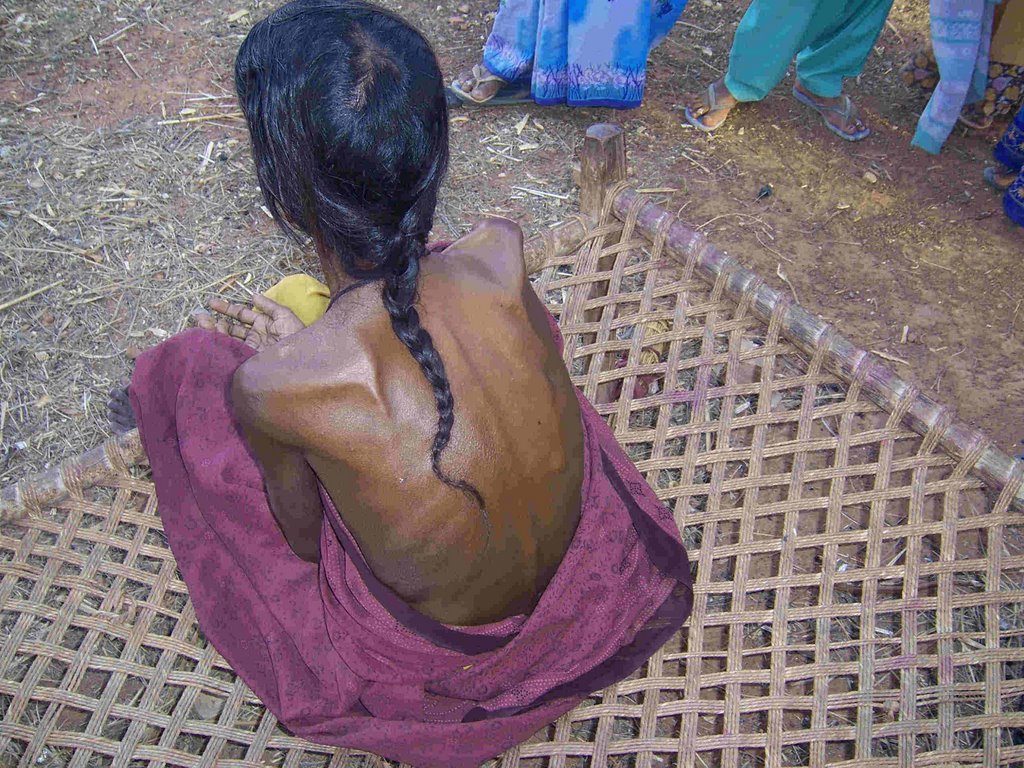
Mirzapur (Uttar Pradesh), March 23, 2006: By the time we reached Damahi Tola, it was 5.00 in the evening. And 65 year old Bichinia Musahar still hadn’t had her breakfast. She doubts whether she will have any before she goes to bed tonight. Almost 24 hours have passed since she had eaten last - she had shared one litti (a baked version of Indian bread) with her seven year old granddaughter last evening. Bichinia displayed us her stomach and she was almost doing a Ramdev with it- pulling her loose skin with both hands and fanning it from one side to the other – to show the state of her empty stomach. Bichinia’s had lost her son who had died of starvation some five years back.Makhnaha is around 50 years old, but looks 20 years older. Last night she had eaten khuddi (broken rice) which she had bagged it from the Patel tola. She had been starving since then. She is a single woman- her son had died few years back out of starvation. And her daughter-in-law had subsequently deserted her to her fate.Bichnia and Makhnaha were just two of the women- selected randomly- from the gathering whom we talked to. A woman activist, Pushpa, of Shikhar Prasikshan Sanstha (SPS) based in Chunar had discovered the five cases of starvation deaths in this small sleepy hamlet of 53 Musahar families. That was last November, almost a month after the deaths had occurred. Part of Jangal Mahal Panchayat in Rajghar Block of Mirzapur district, Damahi tola is around 75 kilometers away from the district Headquarters. The Musahar are known for their poverty and are placed in the lowest rungs of the highly caste based society in north India. Though traditionally known for their occupation of making leaf plates and storing the leftovers from eaten plates -gathered from community feasts- to be taken as daily food, livelihood of the Musahars is today primarily based on minor forest produce.The discovery of the deaths, though, didn’t make much news. Except for one or two small snippets on the visit of the district police and medical chiefs to the village, the local newspapers didn’t find newsy about the incident- ostensibly because it was just another case. But for the letters written to the National and Asian Human Rights Commissions by SPS and Dr. Lenin, an activist from nearby Varanasi, the panjandrums would have hardly cared to visit the hamlet.Mahender is 27. He had had lost his mother and in one months time lost his elder brother as well. We went to his house to see what he had for the evening. He took out a pot to show a handful of cooked rice which he had preciously saved for the dinner for him and his family (see picture). We asked little children what they ate last night and in the day today. “Last night I had rice and tomato chatni, and today I had rice with salt and chilly” said seven year old Rikku. But not all were fortunate like Rikku; some hadn’t any answer!Rikku along with a few kids go to the nearby primary school in the influential Patel tola. Far from providing statutory free education and scholarship to the children, that comes to the school in the name of the children, the Headmaster had extorted 36 Rupees from each parent as admission fee last year. And still the community mustered up all hopes to send their kids to the school- in a hope that the kids would get kichidi (a mix of rice and pulses) to eat. But it is only at times that these children have the fortune as often nothing is left over after distribution of mid-day meals to the children of the privileged communities.An Anganwadi Centre is there in the tola- but floats in mere paper. The Anganwadi worker,Sarika Devi, who comes from the influential Patel community, apparently runs the show from her own house- five Kms. away from the Musahar hamlet. People of the hamlet have never seen Sarika. Neither do they know that an Anganwadi centre is sanctioned in their name.“We have to work each day for living. But there is no work these days. If we get work for 10 days, we are left unemployed 20 days in a month” tells Massali 35. “All of us are victims of huge loans that ranges from 10,000 to 15,000; we take these from the thekedar (contractor) or owners of the stone quarries where we work to repay old debts- at an exorbitant rate of 20 percent per month”, he adds. But none could tell us how much money the village Shylocks owe to them. “Would you be able to redeem your loan in this life time?”, I asked an elderly man. “Me…. no… not even my grand children”, replied he with a heavy frown in his brow.“What about the land of your own; do you have any?”, we asked the people. Replied Dhani 45: “We had land, though little, where we used to grow crops. That was 20 years back when life was not so bad. The government had since than taken over our land for constructing the dam (on river Jargo). They snatched away our lands with no compensation in return. Since last few years, the river has been going dry. And the powerful people in the village has taken over the land and are growing crops there. We are helpless”We inquired as to how the sarkar (government) had responded after cases of starvation deaths reached their ears. The visiting officials came with some quilts, dhotis and slate- pencils for the children. The Sub-Divisional Magistrate had averred of: building houses for 46 families from Indira Awas Scheme, providing red ration cards to all 53 families, and sanctioning four hand-pumps. Almost half a year has passed since than, and most of these seemed to be administrative gimmicks; except for the ration cards, the community has never heard of anything till date. And even in the case of the ration cards, though all have one each in hand by now, none of them have been able to use them yet. If only the government realized that ration cards without enough purchasing power means nothing but mockery with the poor.As we were moving out of the village with a heavy heart, Pushpa insisted that we see a woman who is likely to die in a few days time. We went to Kewli’s house. We lifted her from the ground to the cot. She is less than 50 but has run out of energy -even to speak as she has not eaten for long. We took some photographs of her shoulder, back, leg and arms to capture the degree of malnourishment (see her photograph alongside). Kewli’s daughter-in-law was one of the five starvation victims who paid with her live in September last.When we came out of the hamlet, we saw large number of villagers- man, women and children- from nearby villages lifting mud into a truck. That was part of construction work of the road, undertaken by the Panchayat. “Enough of work, isn’t it!” I exclaimed- wondering why the Musahars just besides the road were not working here. Masali explained “The payment here is made at the end of every week. We can’t afford to wait for that long. So gathering firewood from the jungle or working at the quarry is preferred to working in Panchayat works.” But why can’t the Panchayat pay them daily in that case- I thought.Death due to malnutrition seems not to be a new phenomenon in this small hamlet, according to the community elders. And the community has learnt to accept their destiny. Since the last three-four years, drought situation has particularly worsened and starvation as a phenomenon has become the order of the day. Acute poverty, lack of employable work and provisioning of basic services to the community- all have added qualms in the community. And if sincere efforts are not urgently made to rescue the community from the impending misfortune, Kewli would leave us and so would many more Kewlis.
3.
www.ahrchk.net/ua/mainfile.php/2006/1481/ - 28k
www.ahrchk.net/ua/mainfile.php/2006/1568/ - 29k

[Hunger Alert] INDIA: Starving Musahar community face exploitation in Mirzapur, Uttar Pradesh
HUNGER ALERT HUNGER ALERT HUNGER ALERT HUNGER ALERT HUNGER ALERTASIAN HUMAN RIGHTS COMMISSION - URGENT APPEALS PROGRAM 5 March 2006--------------------------------------------------------------------- HA-02-2006: INDIA: Starving Musahar community face exploitation in Mirzapur, Uttar PradeshCOUNTRY: Hunger and starvation; government neglect; bonded labour; police intimidation ---------------------------------------------------------------------

Dear friends,The Asian Human Rights Commission (AHRC) has received information from the People’s Vigilance Committee on Human Rights (PVCHR) regarding the acute hunger and exploitation of villagers belonging to the Musahar community in Mirzapur District, Uttar Pradesh. A fact finding team, consisting of members from PVCHR and the Right to Food Campaign, visited the villagers in November 2005 and subsequently produced a report highlighting several starvation deaths that have occurred in the area, as well as the continuous and consistent denial of assistance programmes, welfare schemes, and government aide. The team also reported that exploitation, discrimination and police torture still persists against the Musahar community.The AHRC requests that you to write letters to the local administration, asking them to immediately address the hunger concerns of this community and ensure that all assistance schemes are functioning to prevent further starvation deaths from occurring. Moreover, persons, police officers and other concerned government authorities who have been found to be exploiting and torturing villagers of the Musahar community must be charged and punished.

Urgent Appeals Desk - Hunger AlertAsian Human Rights Commission (AHRC)-----------------------------------------------------------

DETAILED INFORMATION:Location: Damahi village, Mahal Jungle, Rajgarh Block, Mirzapur District, Uttar Pradesh

Persons affected: 1. Ramchander, age 18, and his four brothers; their mother died from starvation 2. Amravati, age 123. Krishnavati4. Ramdulari and her family5. Ramshakal and his family6. Heerawati, who died of starvation7. Kevali, age 55, who also died of starvation along with her two daughters in-law, and her family8. Sarju, who died of starvation, his son Phunnu, and their family9. The hundreds of families who live in the Damahi Village and suffer from hunger, malnutrition and starvation.

On 1 November 2005, a fact finding team consisting of members from the Right to Food Campaign and PVCHR visited the Damahi Village in Mirzapur District, Uttar Pradesh. The group heard from numerous families and found that the majority were suffering from acute hunger and malnutrition; several starvation deaths were also reported. The severe hunger situation in the village exists for several reasons. First, although the families are entitled to be under Below Poverty Line (BPL) welfare schemes, no one has received BPL red ration cards. Furthermore, while some families do possess white ration cards, which allow villagers to buy food at slightly higher prices than with red ration cards, many families are unable to purchase food. The rations are either too costly or the public distribution shops that supply the food refuse to sell their goods. A lack of job opportunities also adds to the minimal wages most families earn, particularly those who are landless. Women also tend to be more affected by the hunger as the patriarchal society often means that their needs are secondary to their sons, brothers, fathers and husbands.Second, the village also lacks most basic amenities. There are no Integrated Child Development Service (ICDS) centers in the village, no health centers or hospitals, and no potable water facilities. The lack of all these facilities coupled with the lack of food directly violates the Supreme Court order that safeguards the right to life of all Indian citizens. Additionally, many people have had to work in unfavorable conditions such as in stone quarries, which provides far less than the daily minimum wage per day. Thus, several people have had to take loans out from their employers in order to provide for their basic necessities, which binds them to this work until the debt is paid off. Under the National Rural Employment Guarantee Act, 2005, all persons living below the poverty line are entitled to 100 days of minimum wage labour. However, the scheme has not been implemented in Mirzapur and no alternative means of work exist currently. Third, many villagers have also alleged that the Musahar community in Mirzapur have been continuously exploited, threatened and intimidated by feudal lords and the police. There have been instances of land grabbing, where feudal lords have forcibly taken property owned by the villagers and destroyed their land. Violence is often used against daily wage labourers as well, particularly stone quarry workers who are bonded to their jobs, and work in intolerable conditions for well below minimum wage. Finally, the villagers are often intimidated by police officers who label them as Naxalites, when the victims are just trying to fight for their rights.Below are several personal statements from victims of hunger in the area, highlighting these human rights abuses and violations that are occurring against the Musahar community.Ramchander: “I have four brothers, one of them is handicapped. We have no land. My mother was ill and had been suffering from a hunger-related illness. In order to fund her medical treatment, I had to take out loans of Rs. 10,000, but no officials or doctors came to my house. She passed away without having eaten food for five days. There is no hospital in the village or even nearby. In an emergency, we have to go to Ahraura, the nearest market, and often people die half way. There is no drinking water in the village so we have to bring water from the river. “The village head has bought his votes and does not care about the poor people. Our livelihoods depend upon my work, which is to collect dry wood from the jungle. Every morning, we go into the jungle, often times without food, collect wood, and then travel to the market to sell the bundles. I can normally make Rs. 50 - 70 for two days of work. I also work in the stone quarries, under Rakesh Patel. He only pays Rs. 5 - 6, which is half of the normal wage rate. If one dares to leave the work, they would certainly be beaten.”Amravati: “I go to the jungle to collect dry wood. I do not have food on a daily basis and often, I have to go through long periods of no food.”Krishnavati: “When the Musahars and Kols demand our rights, we have been called Naxalites. So many innocent people have been beaten badly and have been arrested because they consider us to be terrorists, when all we are doing is asking for assistance.”Ramdulari: “I belong to the Chamar community. There is a piece of agricultural land in my mother’s name. But Lallan Patel, one of the feudal lords in the area, has taken possession over that land. He destroyed our entire crop of Parval (an Indian vegetable) which was valued at up to Rs. 10,000. However, the police have taken no action against this man, who has clearly stolen and destroyed our property.”Ramshakal: “I have a white ration card, which allows me access to partially subsidized food; I can buy up to 35 kg in rice and wheat. However, I never get any food grains. I work as a labourer in a stone quarry belonging to Krishna Kumar. I took a loan of Rs. 7,000 - 8,000 from this man and now I cannot stop working as a labourer there until I pay back my debt. If I leave, I will be severely beaten.”Daughter of Heerawati: “My mother died of hunger some time back. Now all we can manage to eat is some dry bread. Mostly though, I just collect barja from the fields and eat it raw, without roasting or cooking it.”Kevali: “My family and I don’t have ration cards. Due to extreme hunger and the lack of food, my daughter in-law (Heerawati) died of starvation three years ago. My other daughter in-law, Munga, also recently passed away due to hunger. Munga did not eat for four days before she died.“My son, Vishnu, has even taken a loan from his employer, Rakesh Chauhan, in order to get medical treatment and food for the rest of us. But it only provided temporary help and we are now living with almost no food again.” Please note, Kevali also died of starvation after the visit.Phunnu: “My father, Sarju, died of starvation on 8 October 2005. He had not eaten anything for five days before he died. I work at a stone quarry belonging to Rampos and had to take a loan of Rs. 850 from him because on average, I only earn about Rs. 25 daily. It is not enough money for me to support my family but I have no option to leave.”SUGGESTED ACTION:Please write to the relevant authorities below urging them to immediately investigate the situation and provide the necessary assistance programmes to the starving Musahar community. Immediate relief should be provided to the victims, which includes red ration cards and functioning public distribution shops. ICDS and medical centers should also be provided in the long-run. Furthermore, the National Rural Employment Guarantee Act, 2005 must be implemented in the village, and those in bonded labour need be released, and rehabilitation and compensation provided under the Bonded Labour Act, 1976. Finally, those feudal lords, police officials and stone quarry owners found to be exploiting and intimidating the villagers and their land must be reprimanded and prosecuted for their abuses.

Suggested Letter:

Dear ____________RE: INDIA: Starving Musahar community face exploitation in Mirzapur, Uttar PradeshLocation: Damahi village, Mahal Jungle, Rajgarh Block, Mirzapur District, Uttar PradeshPersons affected: 1. Ramchander, his family, mother and four brothers 2. Amravati, age 123. Krishnavati4. Ramdulari and her family5. Ramshakal and his family6. Heerawati, who died of starvation7. Kevali, age 55, who also died of starvation along with her two daughters in-law, and her family8. Sarju, who died of starvation, his son Phunnu, and their family9. The hundreds of families who live in the Damahi Village and suffer from hunger, malnutrition and starvation.I am writing to draw your attention to the severe hunger situation that currently exists in Damahi Village, Mirzapur. On 1 November 2005, a fact finding team consisting of members from the Right to Food Campaign and the People’s Vigilance Committee on Human Rights (PVCHR) visited the village and found that the majority of villagers were suffering from hunger and malnutrition. Many families also reported starvation deaths in their families. I was given detailed information on several personal stories of villagers who have been seriously affected by the hunger. One woman, Kevali, told of how her two daughters in-law died of starvation. Kevali died not long after she was interviewed after not eating for days. Another young girl informed the team that she did not eat on a daily basis, while another talked of how when her family does eat, it is only dry bread or barja collected from the fields. Although everyone in the village should be under Below Poverty Level (BPL) assistance schemes, no one has a red ration cards. Some villagers have white ration cards, as Ramshakal does, however, food cannot be bought because it is either still too costly or the Public Distribution Shops (PDS) do not sell the grain.I was also informed that the villagers also lack all basic necessities in the area. There are no ICDS centers or schools in the village, and no access to potable water. Medical facilities are also lacking, people must travel to a market to get to the nearest hospital, which is expensive. Often times in emergencies, the patient dies en route to seeking medical attention. Additionally, many people have had to work in unfavorable conditions, such as stone quarries, which provides far less than the daily minimum wage per day. Thus, several people have had to take loans out from their employers in order to provide for their basic necessities, which further binds them to this work until the debt is paid off. Under the National Rural Employment Guarantee Act, 2005, all persons living below the poverty line are entitled to 100 days of minimum wage labour. However, the scheme has not been implemented in Mirzapur and no alternative means of work currently exist. Finally, members of the Musahar community continue to be exploited and intimidated by feudal lords and police. I was told of numerous cases where labourers were scared to leave their jobs for fear of being beaten. Feudal lords have also been accused of land grabbing and destroying the crops of what little property the villagers own. Ramdulari informed us that her family owns a plot of land in her mother’s name, yet one feudal lord took possession of it and then proceeded to destroy the family’s crops. Moreover, it wa s brought to my attention that many of the villagers who complain or fight for their rights then become labeled as Naxalites, which then categorizes them as terrorists. Police often times will use violence against these villagers who are only trying receive assistance.I strongly urge you to investigate this hunger situation and the other circumstances causing the starvation deaths and suffering in the village. Immediate relief should be provided to the victims, which includes red ration cards to those living below the poverty line and fully-functioning public distribution shops. ICDS and medical centers and wells should also be provided in the long-run. Furthermore, the National Rural Employment Guarantee Act, 2005 must be implemented in the village to provide alternative sources of income for the families. Those villagers currently in bonded labour need be released, and rehabilitation and compensation provided under the Bonded Labour Act, 1976. Finally, those feudal lords, police officials and stone quarry owners found to be exploiting and intimidating the villagers and their land must be reprimanded and prosecuted for these violations.I trust you will take immediate action in this matter. Yours sincerely,---

PLEASE SEND LETTERS TO:

Mr. Mulayam Singh YadavChief Minister of Uttar PradeshChief Minister's SecretariatLucknow, Uttar PradeshINDIAFax: + 91-522-2230002/2239234Email: csup@up.nic.in

PLEASE SEND COPIES TO:

1. Mr. Umesh Kumar Mittal, District Magistrate,Mirzapur DistrictUttar PradeshINDIATel: +91 54 4225 2480, 7400Fax: +91 54 4225 2552Email: mir@up.nic.in

2. Sub Divisional MagistrateChunar, Mirzapur District

Uttar Pradesh

INDIA

Tel: +91 54 4222 2413

3.Justice A. S. Anand,National Human Rights CommissionSardar Patel Bhaven, Sansad Marg,New Delhi - 110 001 INDIATel: + 91 11 23346244Fax: + 91 11 23366537E-mail: ionhrc@hub.nic.in or chairnhrc@nic.in

4. Justice A P MishraChairpersonUttar Pradesh Human Rights Commission6-A Kalidass MargLucknow Uttar PradeshINDIA

5. Mr. Jean ZieglerUNCHR, Special Rapporteur on the Right to Foodc/o Mr. Carlos Villan DuranRoom 4-066 OHCHR,Palais Wilson, Rue des Paquis 52, GenevaSWITZERLANDFax: +41 22 917 9010 Email: sect.hchr@unog.ch

6. Mr. Anthony BanburyRegional Director World Food ProgrammeUnit No. 2, 7th FloorWave Place Building 55 Wireless Road Lumpini, PatumwanBangkok 10330THAILANDTel: +66-2-6554115Fax: +66-2-6554413Email: Anthony.banbury@wfp.org or Bkk.unescap@un.org

7. Mr. Gian Pietro BordignonCountry Director World Food Programme 2 Poorvi Marg, Vasant Vihar, New Delhi 110057INDIATel: +91-11-26150000Fax: +91-11-26150019Email: wfp.newdelhi@wfp.org

8. Dr. N.C. Saxena and Mr. S.R. SankaranCommissioners Supreme Court of IndiaSAMYA, R-38A, 2nd floor South Extension - part 2New Delhi - 49INDIAFax: +91-11-5164 2147Email: commissioners@vsnl.net

Thank you.Urgent Appeals Programme -- Hunger Alert Asian Human Rights Commission (AHRC)
Posted on 2006-03-05
Back to [2006 Urgent Appeals]