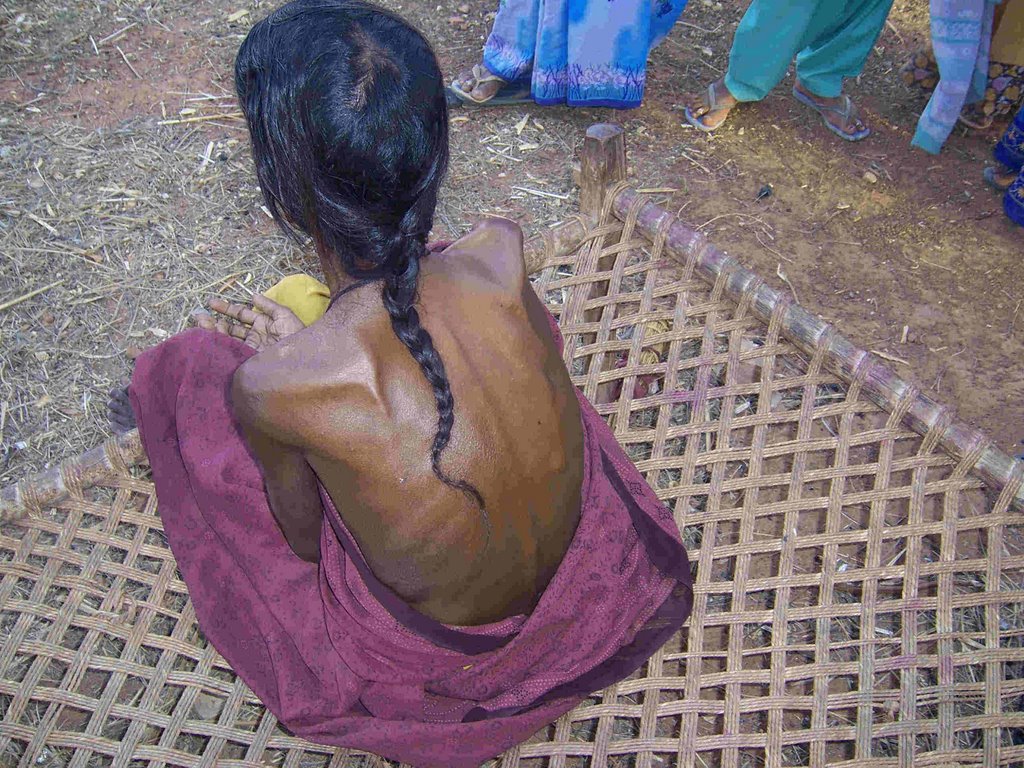
Struggle of Musahars in Damhi of Mirzapur, India: A ray of hope against marginalization
Local thinking, local-global action
We wanted to bring to your kind notice that the hunger situation of Musahar community of Damahi village of Mirzapur was first brought into light by People’s Vigilance committee on Human Rights and Shikhar Prashishan Sanstan (SPS) in 2005.After the interference of PVCHR and SPS, people from Musahar community in the village came forward and narrated their sufferings and miseries before the members of Human Rights activists associated with PVCHR and SPS. Here it is important to note that initially people of this marginalized community were reluctant and afraid of to explain their situation before the Human Rights activists, but when they were encouraged and mobilized to explain their situation. Then after some hesitation few people came forward and talked about their hunger situation with the member of fact finding team and thus they uncensored themselves against the fear of feudal system and feudal forces.
As a result of this fact finding team became successful to collect facts regarding the hunger situation, practices of bonded labour, absolute crisis of rule of law, corruption in PDS system and torture of marginalized community and class by the local police in the name of Naxalism. On the basis of these findings Asian Human Rights Commission (AHRC), Hong Kong issued the urgent and hunger appeals and PVCHR filed petitions to Chief Secretary of UP, District Magistrate of Mirzapur, National Human Rights Commission, Supreme Court commissioners on the Right to Food as being a loudspeakers for the marginalized community with definite intention to convert the private opinion of Musahars of Damahi village in to public opinion. Further AHRC raised this matter before UN, International and national Human Rights institutions. Collective pressure created by more than two hundred thousand people across the world, NHRC sent notice to DM of Mirzapur and principal secretary of UP to clarify the situation and submit report within four week .As a result of this first time officials of District administrating made a visit in the village and people of Musahar community of Damahi were granted 53 AAY red cards, some food grains was distributed among starving families as an emergency action, and four hand pumps. Even though they were provided with Red ration cards but they were not receiving food grains from PDS shop. Then the people of Musahar community first time staged protest procession and Dharana before Sub- Divisional Magistrate (SDM) demanding food grains since then they are getting food grains every month. Meanwhile PVCHR and SPS involved IBN-CNN and Times of India and other media to highlight the hunger situation of Damahi Village and to enroll them under NREGA, allotment of land and stone quarries in the favour of Musahars and to ensure the livelihood of the marginalized community. Recently ADM, CDO, DDO, SDM, BDO and other grass root officials made a visit in the village and taking a important step they granted 54 Job cards under NREGA and allotted one Bigha(2/3 Acre) land to each Musahar family i.e. all 53 Bighas land allotted to all 53 Musahar families. But still no action has been taken against the responsible persons under the SC/ST act and Bonded labour Abolition Act.
Further we demand from District administration:
1.To give possession over the allotted land immediately.
2. To provide essential resources for collective farming and collective stone quarry.
3. To take action under the SC/ST Act and Bonded Labour Abolition Act.
We demand from Planning Commission of India:
To initiate special package program in the favour of Musahar of eastern UP.
We demand from Civil Society:
To support and participate with the struggle of Musahar.
To provide essential resources for collective farming and collective stone quarry.
We demand from SPS:
To support and participate with the struggle of Musahar
To organize and train the Musahars for collective farming and collective stone quarry.
With warm regards,
All members of core Group of PVCHR (Dr.Mahendra Pratap,Dr. Lenin,Jai Kumar Mishra,Shruti,Lal Bahadur Ram,Lal Bahadur Patel,Shanti Devi and Prashant) and Shiv Prasad Singh, Intern-AHRC
Please see the following annexure:
1.Starving musahar community is still facing exploitation and police torture
Sandhya and Mithiles of Shikher Prashikshan Sansthan informed that in village Damahi of Jangal Mahal under Rajgarh Block in district Mirzapur, people of musahar community were dying of starvation. On their information PVCHR, a partner of Right to Food campaign, formed an inquiry team and made a visit to that village on 1 November 2005, 24 Km. away from Chunar. Having traveled 6 Km. through an unpitched road inquiry team reached to Jungle Mahal. Leaving their car behind, members of inquiry team had to walk on foot a distance of 1-5 Km to reach the villageDamahi.
Following members were there in the inquiry team- Mr. Lenin : State co-coordinator of Right to Food Campaign.Shruti- Coordinator of Savitri Ba Phule Mahila Panchayat.Sandhya- Mahila Adhikar Manch.Anupam- a member of core team of PVCHR.
Statement of members of victim families and fellow villagers
Ramchander (18 Years) S/o. Sri Rajnarayan- I have 4 brothers, one of them is handicapped. I have no land. My mother was ill. She had been suffering from hunger-oriented illness.Taking debt I managed medical treatment for my mother. She had taken no food for 5 days before she died. But neither any official from Block nor village head nor any doctor came to my house. Village head says that he has purchased the vote and he does not care the poor people. Hardly, I find work in an agricultural field through out the whole year. Our livelihoods depend upon collection of dry woods from the jungles. Early in the morning, often we go to the Jungle without food tocollect dry woods. In the evening after returning from jungle I go to market to sell the bundle of dry woods. Next day, by selling the dry woods I earn Rs. 50 to 70. I mean for two days work, I earn Rs.50 to 70. There is no hospital in the village or nearby area. In emergency we have to go to Ahraura(a nearest market). Often patients die in the half way. There is no resource of drinking water in the village. We bring water to drink from the nearby river. I do work in the stone quarry of Rakesh Patel at Shakteshgarh. For medical treatment of my mother and for other essential requirements, I have taken a debt of Rs 10000 from my employer Rakesh Patel. He pays only Rs. 5 to 6 out of Rs. 10, which is actual wage rate. If one dares to leave the work, certainly would be beaten.
Amravati a 12 Years old girl of musahar community told that she used to go the Jungle to collect dry woods. She told that she did not have food for daily. Often she becomes forced to go without food.
Krishnavati Kol told that when musahars and Kols did make demand for their rights, they were called Naxalites. So many innocent persons were beaten badly and were taken away by police.
Ramdulari told that she belonged to Chamar community. There is a piece of agricultural land in the name of her mother. Lallan Patel, and backward caste man of neo-feudal approach, has taken possession over that land. He destroyed the whole plantation of Parval(a kind of vegetable plants) which valued up to Rs.10,000/-. Police took no action against the culprit Lallan Patel.
Ramshakal Musahar told that he had white ration card but never get any food grains. He works as a laborer in the stone quarry of Krishna kumar. He has taken debt from him up to Rs. 7000-8000/. He says that he cannot stop the work, as a labor, of that man until he did not pay the whole debt back to his Employer. If one dares to quit the work, he would be beaten badly.
Daughter of Heerawati (Heerawati died of hunger) told that she could have got only dry bread to eat. She collects Bajra from the fields and eats it without roasting or cocking.
Kevali 55 years (she died after visit of team) old women told that she had no ration card. Due to hunger, her daughter in-law named Heerawati had died 3 years ago and her other younger daughter in law Munga also died of hunger. Munga could not get food for 4 previous days, before she died.
Son of Kevali, Vishnu told that taking debt from his employer Rakesh Chauhan he, some how managed to give medical treatment for her mother. (Be it known that Kevali too died of hunger after some days.)
Phunnu s/o Late Sarju told that on 8th October his father Sarju died of hunger. For 5 days before he died, he could not be able to give him food. He does not get food for everyday. He works in the stone quarry of Rampos of Bairampur. He has taken a loan of Rs. 850 from his employer Rampos. He gets Rs25 to 30 as daily wage. He cannot leave the work on the basis of low wage rate because he has no option.
Secretary of Shikhar Prashikshan Sansthan Sandhya told that she had been working since 1997 among mushar, kol and dalit communities to organize and educate them. She told that until some years back, mushars had not been dying of starvation. They used to collect leaves from the Jungle but now they could not take the leaves from there. Forest department does not allow them to enter into the Jungle. There had been drought for last two years. Agriculture has been a matter of loss due to which they to not find agricultural work. Women of mushahar community are worst affected and they are dying.
Convener of Savitri Ba phule mahila panchayat Shruti was taken aback knowing that on the very day of Deewali, here people are going without food. These people do not have food grains. It is undoubtedly nothing but havoc of hunger. People do not have red cards. They are not getting food grains on white card. They do not find work under the scheme of Food for Work. Employers are exploiting the laborers. In such a situation how may these people save their right to life? Musahars have no food. Women of these families hardly get food in the last because due to patriarchal structure of family they can take food at last if it remains. This is the reason, why cases of hunger deaths of women are more common than the women.
Campaign Coordinator of Right to Food Campaign, UP Dr. Lenin said that, Chief Secretary, District Magistrate and Chief Minister were celebrating Deevali but at the some time mushahar community was facing starvation. It is shameful for independent India.
CONCLUSION-· Musahar of Damhi Tola of Jungle Mahal of Rajgarh Block in district Mirzapur has died of hunger and hunger oriented illness and still facing starvation.· Widow women like Makhan Mushahar (75 yrs.) who is qualified for widow pension scheme, is deprived of the benefit of the scheme.· Musahars of Damhi Tola are dying of Starvation but they do not have red cards. It they are qualified to get the benefits of food securities, then why is they deprived of that. Those who have white cards are not getting food grains. · Collusion between police and feudal forces is being exercised to torture musahar and Kol communities. But Police do not take any action against the perpetrators belonging to upper caste under SC/ST Act 1989 and Bonded Labor Act, 1976, who take possession over their land forcefully and destroy their crops and pay wages less than the minimum wage rate. Thus administration and police are making violation of article 14 of the Indian constitution. It is crisis of Rule of law. Poor people are frightened and find them unable to exercise their essential rights and they are dying of starvation. It is happening due to prejudiced nature of administration. In the village people have not got work under the scheme of “food for work”. There is no ICDS center in the Musahar Tola which is violation of directions of Honorable Supreme Court.· UP Government has already issued a GO dated 22 Dec.2004 under which a contingency fund has been set up to provide immediate relief for starving family but it has not been followed in this case.· Negligence on the part of state Government and District administration: It should be noted that on an earlier complaint made by us, DR. N.C. Saxena Supreme Court commissioner had given to chief secretary of UP (Hungercomp/311/UP dated 05.06.2005) the following direction:
Performance of the food Schemes A look at the available information on food schemes implemented in these districts presents a very grim picture. In Varanasi, Sonebhadra, Jaunpur, Khusinagar and Mirzapur, from where the deaths are reported, only 31% of the children under 0-6 age group are covered by ICDS. Seventy-one additional ICDS projects (in addition to the existing 64 projects) are required to cover the population as per existing norms. Even among the existing 64 projects nearly 9% of the anganwadi centres are not reporting to your Department of Women and Child Development. The staffing in these projects is also very poor with non-appointment of 19% of the sanctioned anganwadi workers (AWWs) and 30 % of the sanctioned anganwadi helpers (AWHs) in Mirzapur and 11% of the sanctioned AWWs and 12 % of the sanctioned AWHs in Jaunpur (see appendix 2).In the case of employment related schemes, the five aforementioned districts have utilized only 78% of the allocated funds and 56% of sanctioned food grains under the Sampoorna Gramin Rozgar Yojana (SGRY). Again Mirzapur performed worst with only 39% utilization of food grains. This is despite the fact that Mirzapur is a poor district, and here the percentage of agricultural labour to main workers is 33.78 % (as against 21.4% for UP) and percentage of marginal workers to main workers is 3.39 % (as against 2.94 % for UP). Except Jaunpur in the other three districts (Varanasi, Sonebhadra and Khusinagar) too the proportion of agriculture workers and marginal workers to main workers is much higher than that in U.P. on average.Though in addition to SGRY, the National Food for Work Scheme was also in operation in districts of Sonebhadra, Mirzapur and Khusinagar, only 7.5 % and 8.6 % of the funds and food-grains were utilized in these districts.Another fact which is distressing is that in districts of Varanasi, Jaunpur and Khusinagar, women beneficiaries under SGRY constituted of only 13%, 4%and 18% of the total beneficiaries, which is much below the norm of 30 %, which is the proportion of reservation for women in employment schemes.In light of continued reports of hunger deaths and poor implementation of food schemes, I recommend the following: o Set up district-wise enquiries on the reported hunger deaths and provide necessary assistance to these families.o In a letter dated 9.11.2004, No. 3872/26-06-04, it was mentioned that to prevent malnutrition deaths, discussions are in process to make the village level officials and gram pradhan accountable and to provide adequate funds at district level to provide immediate relief to people in danger of hunger. It was also mentioned that I will be briefed on steps taken on these soon. I request you to kindly update me on the developments in this regard.o Ensure that all AWCs are operational and reporting and all vacancies are filled in ICDS projects; further send us the details on the steps taken to increase the number of ICDS projects as per existing guidelines.o Send a report on the reasons for low utilization under SGRY and NFFWSs and action taken to ensure full utilization of food grain and funds under these schemes.
Demands-
1. Immediate relief should be given to the hunger victim families and action should be taken against village head and village secretary and lekhpal.
2. Under the Employment Guarantee Bill 2005, immediately, needy people should be given work for at least 100 days by preparing their list.
3. Action should be taken under Bonded labour Act, 1976 to release stone quarry workers, initiative should be taken to implement extensive rehabilitation programme for them. Stone quarries should be allotted to the workers on lease.
4. Owners of stone quarries are involved in illegal quarries work. It must be checked and revenue collection should be increased.
5. All qualified poor people should be given red cards immediately. Identifying the old women like Makhan,they should be issued Annapurna card.
6. Making judicial inquiry of the police atrocities against musahars and kols in the name of Naxalism. Rule of law should be established so that ultra leftist violence in the reaction of feudal atrocities could be discouraged.
7. In the matter of forceful possession over the land of Ramvati by Lallan patel and for destroying her crop of Parval(a kind of vegetable plants) action should be taken under section 3(1) viii, 3(1) xi, 3(1)ix of SC/ST Act against the culprit. Under rule of SC/ST Act, making a visit of that village, DM and SP should take initiatives for rehabilitation of them under rule of the Act.
8. Strict implementation of Directions of Supreme Court’s commissioners should be ensured.
Video footage of the statements given above made by members of victim families and fellow villagers is available on request. Report is translated in English and edited by Shiv Prasad Singh (Adv.)
2. Saturday, April 15, 2006
Manoj Kumar Das
Where People Live and Die with Empty Stomachs
Mirzapur (Uttar Pradesh), March 23, 2006: By the time we reached Damahi Tola, it was 5.00 in the evening. And 65 year old Bichinia Musahar still hadn’t had her breakfast. She doubts whether she will have any before she goes to bed tonight. Almost 24 hours have passed since she had eaten last - she had shared one litti (a baked version of Indian bread) with her seven year old granddaughter last evening. Bichinia displayed us her stomach and she was almost doing a Ramdev with it- pulling her loose skin with both hands and fanning it from one side to the other – to show the state of her empty stomach. Bichinia’s had lost her son who had died of starvation some five years back.Makhnaha is around 50 years old, but looks 20 years older. Last night she had eaten khuddi (broken rice) which she had bagged it from the Patel tola. She had been starving since then. She is a single woman- her son had died few years back out of starvation. And her daughter-in-law had subsequently deserted her to her fate.Bichnia and Makhnaha were just two of the women- selected randomly- from the gathering whom we talked to. A woman activist, Pushpa, of Shikhar Prasikshan Sanstha (SPS) based in Chunar had discovered the five cases of starvation deaths in this small sleepy hamlet of 53 Musahar families. That was last November, almost a month after the deaths had occurred. Part of Jangal Mahal Panchayat in Rajghar Block of Mirzapur district, Damahi tola is around 75 kilometers away from the district Headquarters. The Musahar are known for their poverty and are placed in the lowest rungs of the highly caste based society in north India. Though traditionally known for their occupation of making leaf plates and storing the leftovers from eaten plates -gathered from community feasts- to be taken as daily food, livelihood of the Musahars is today primarily based on minor forest produce.The discovery of the deaths, though, didn’t make much news. Except for one or two small snippets on the visit of the district police and medical chiefs to the village, the local newspapers didn’t find newsy about the incident- ostensibly because it was just another case. But for the letters written to the National and Asian Human Rights Commissions by SPS and Dr. Lenin, an activist from nearby Varanasi, the panjandrums would have hardly cared to visit the hamlet.Mahender is 27. He had had lost his mother and in one months time lost his elder brother as well. We went to his house to see what he had for the evening. He took out a pot to show a handful of cooked rice which he had preciously saved for the dinner for him and his family (see picture). We asked little children what they ate last night and in the day today. “Last night I had rice and tomato chatni, and today I had rice with salt and chilly” said seven year old Rikku. But not all were fortunate like Rikku; some hadn’t any answer!Rikku along with a few kids go to the nearby primary school in the influential Patel tola. Far from providing statutory free education and scholarship to the children, that comes to the school in the name of the children, the Headmaster had extorted 36 Rupees from each parent as admission fee last year. And still the community mustered up all hopes to send their kids to the school- in a hope that the kids would get kichidi (a mix of rice and pulses) to eat. But it is only at times that these children have the fortune as often nothing is left over after distribution of mid-day meals to the children of the privileged communities.An Anganwadi Centre is there in the tola- but floats in mere paper. The Anganwadi worker,Sarika Devi, who comes from the influential Patel community, apparently runs the show from her own house- five Kms. away from the Musahar hamlet. People of the hamlet have never seen Sarika. Neither do they know that an Anganwadi centre is sanctioned in their name.“We have to work each day for living. But there is no work these days. If we get work for 10 days, we are left unemployed 20 days in a month” tells Massali 35. “All of us are victims of huge loans that ranges from 10,000 to 15,000; we take these from the thekedar (contractor) or owners of the stone quarries where we work to repay old debts- at an exorbitant rate of 20 percent per month”, he adds. But none could tell us how much money the village Shylocks owe to them. “Would you be able to redeem your loan in this life time?”, I asked an elderly man. “Me…. no… not even my grand children”, replied he with a heavy frown in his brow.“What about the land of your own; do you have any?”, we asked the people. Replied Dhani 45: “We had land, though little, where we used to grow crops. That was 20 years back when life was not so bad. The government had since than taken over our land for constructing the dam (on river Jargo). They snatched away our lands with no compensation in return. Since last few years, the river has been going dry. And the powerful people in the village has taken over the land and are growing crops there. We are helpless”We inquired as to how the sarkar (government) had responded after cases of starvation deaths reached their ears. The visiting officials came with some quilts, dhotis and slate- pencils for the children. The Sub-Divisional Magistrate had averred of: building houses for 46 families from Indira Awas Scheme, providing red ration cards to all 53 families, and sanctioning four hand-pumps. Almost half a year has passed since than, and most of these seemed to be administrative gimmicks; except for the ration cards, the community has never heard of anything till date. And even in the case of the ration cards, though all have one each in hand by now, none of them have been able to use them yet. If only the government realized that ration cards without enough purchasing power means nothing but mockery with the poor.As we were moving out of the village with a heavy heart, Pushpa insisted that we see a woman who is likely to die in a few days time. We went to Kewli’s house. We lifted her from the ground to the cot. She is less than 50 but has run out of energy -even to speak as she has not eaten for long. We took some photographs of her shoulder, back, leg and arms to capture the degree of malnourishment (see her photograph alongside). Kewli’s daughter-in-law was one of the five starvation victims who paid with her live in September last.When we came out of the hamlet, we saw large number of villagers- man, women and children- from nearby villages lifting mud into a truck. That was part of construction work of the road, undertaken by the Panchayat. “Enough of work, isn’t it!” I exclaimed- wondering why the Musahars just besides the road were not working here. Masali explained “The payment here is made at the end of every week. We can’t afford to wait for that long. So gathering firewood from the jungle or working at the quarry is preferred to working in Panchayat works.” But why can’t the Panchayat pay them daily in that case- I thought.Death due to malnutrition seems not to be a new phenomenon in this small hamlet, according to the community elders. And the community has learnt to accept their destiny. Since the last three-four years, drought situation has particularly worsened and starvation as a phenomenon has become the order of the day. Acute poverty, lack of employable work and provisioning of basic services to the community- all have added qualms in the community. And if sincere efforts are not urgently made to rescue the community from the impending misfortune, Kewli would leave us and so would many more Kewlis.
3.
www.ahrchk.net/ua/mainfile.php/2006/1481/ - 28k
www.ahrchk.net/ua/mainfile.php/2006/1568/ - 29k
[Hunger Alert] INDIA: Starving Musahar community face exploitation in Mirzapur, Uttar Pradesh
HUNGER ALERT HUNGER ALERT HUNGER ALERT HUNGER ALERT HUNGER ALERTASIAN HUMAN RIGHTS COMMISSION - URGENT APPEALS PROGRAM 5 March 2006--------------------------------------------------------------------- HA-02-2006: INDIA: Starving Musahar community face exploitation in Mirzapur, Uttar PradeshCOUNTRY: Hunger and starvation; government neglect; bonded labour; police intimidation ---------------------------------------------------------------------
Dear friends,The Asian Human Rights Commission (AHRC) has received information from the People’s Vigilance Committee on Human Rights (PVCHR) regarding the acute hunger and exploitation of villagers belonging to the Musahar community in Mirzapur District, Uttar Pradesh. A fact finding team, consisting of members from PVCHR and the Right to Food Campaign, visited the villagers in November 2005 and subsequently produced a report highlighting several starvation deaths that have occurred in the area, as well as the continuous and consistent denial of assistance programmes, welfare schemes, and government aide. The team also reported that exploitation, discrimination and police torture still persists against the Musahar community.The AHRC requests that you to write letters to the local administration, asking them to immediately address the hunger concerns of this community and ensure that all assistance schemes are functioning to prevent further starvation deaths from occurring. Moreover, persons, police officers and other concerned government authorities who have been found to be exploiting and torturing villagers of the Musahar community must be charged and punished.
Urgent Appeals Desk - Hunger AlertAsian Human Rights Commission (AHRC)-----------------------------------------------------------
DETAILED INFORMATION:Location: Damahi village, Mahal Jungle, Rajgarh Block, Mirzapur District, Uttar Pradesh
Persons affected: 1. Ramchander, age 18, and his four brothers; their mother died from starvation 2. Amravati, age 123. Krishnavati4. Ramdulari and her family5. Ramshakal and his family6. Heerawati, who died of starvation7. Kevali, age 55, who also died of starvation along with her two daughters in-law, and her family8. Sarju, who died of starvation, his son Phunnu, and their family9. The hundreds of families who live in the Damahi Village and suffer from hunger, malnutrition and starvation.
On 1 November 2005, a fact finding team consisting of members from the Right to Food Campaign and PVCHR visited the Damahi Village in Mirzapur District, Uttar Pradesh. The group heard from numerous families and found that the majority were suffering from acute hunger and malnutrition; several starvation deaths were also reported. The severe hunger situation in the village exists for several reasons. First, although the families are entitled to be under Below Poverty Line (BPL) welfare schemes, no one has received BPL red ration cards. Furthermore, while some families do possess white ration cards, which allow villagers to buy food at slightly higher prices than with red ration cards, many families are unable to purchase food. The rations are either too costly or the public distribution shops that supply the food refuse to sell their goods. A lack of job opportunities also adds to the minimal wages most families earn, particularly those who are landless. Women also tend to be more affected by the hunger as the patriarchal society often means that their needs are secondary to their sons, brothers, fathers and husbands.Second, the village also lacks most basic amenities. There are no Integrated Child Development Service (ICDS) centers in the village, no health centers or hospitals, and no potable water facilities. The lack of all these facilities coupled with the lack of food directly violates the Supreme Court order that safeguards the right to life of all Indian citizens. Additionally, many people have had to work in unfavorable conditions such as in stone quarries, which provides far less than the daily minimum wage per day. Thus, several people have had to take loans out from their employers in order to provide for their basic necessities, which binds them to this work until the debt is paid off. Under the National Rural Employment Guarantee Act, 2005, all persons living below the poverty line are entitled to 100 days of minimum wage labour. However, the scheme has not been implemented in Mirzapur and no alternative means of work exist currently. Third, many villagers have also alleged that the Musahar community in Mirzapur have been continuously exploited, threatened and intimidated by feudal lords and the police. There have been instances of land grabbing, where feudal lords have forcibly taken property owned by the villagers and destroyed their land. Violence is often used against daily wage labourers as well, particularly stone quarry workers who are bonded to their jobs, and work in intolerable conditions for well below minimum wage. Finally, the villagers are often intimidated by police officers who label them as Naxalites, when the victims are just trying to fight for their rights.Below are several personal statements from victims of hunger in the area, highlighting these human rights abuses and violations that are occurring against the Musahar community.Ramchander: “I have four brothers, one of them is handicapped. We have no land. My mother was ill and had been suffering from a hunger-related illness. In order to fund her medical treatment, I had to take out loans of Rs. 10,000, but no officials or doctors came to my house. She passed away without having eaten food for five days. There is no hospital in the village or even nearby. In an emergency, we have to go to Ahraura, the nearest market, and often people die half way. There is no drinking water in the village so we have to bring water from the river. “The village head has bought his votes and does not care about the poor people. Our livelihoods depend upon my work, which is to collect dry wood from the jungle. Every morning, we go into the jungle, often times without food, collect wood, and then travel to the market to sell the bundles. I can normally make Rs. 50 - 70 for two days of work. I also work in the stone quarries, under Rakesh Patel. He only pays Rs. 5 - 6, which is half of the normal wage rate. If one dares to leave the work, they would certainly be beaten.”Amravati: “I go to the jungle to collect dry wood. I do not have food on a daily basis and often, I have to go through long periods of no food.”Krishnavati: “When the Musahars and Kols demand our rights, we have been called Naxalites. So many innocent people have been beaten badly and have been arrested because they consider us to be terrorists, when all we are doing is asking for assistance.”Ramdulari: “I belong to the Chamar community. There is a piece of agricultural land in my mother’s name. But Lallan Patel, one of the feudal lords in the area, has taken possession over that land. He destroyed our entire crop of Parval (an Indian vegetable) which was valued at up to Rs. 10,000. However, the police have taken no action against this man, who has clearly stolen and destroyed our property.”Ramshakal: “I have a white ration card, which allows me access to partially subsidized food; I can buy up to 35 kg in rice and wheat. However, I never get any food grains. I work as a labourer in a stone quarry belonging to Krishna Kumar. I took a loan of Rs. 7,000 - 8,000 from this man and now I cannot stop working as a labourer there until I pay back my debt. If I leave, I will be severely beaten.”Daughter of Heerawati: “My mother died of hunger some time back. Now all we can manage to eat is some dry bread. Mostly though, I just collect barja from the fields and eat it raw, without roasting or cooking it.”Kevali: “My family and I don’t have ration cards. Due to extreme hunger and the lack of food, my daughter in-law (Heerawati) died of starvation three years ago. My other daughter in-law, Munga, also recently passed away due to hunger. Munga did not eat for four days before she died.“My son, Vishnu, has even taken a loan from his employer, Rakesh Chauhan, in order to get medical treatment and food for the rest of us. But it only provided temporary help and we are now living with almost no food again.” Please note, Kevali also died of starvation after the visit.Phunnu: “My father, Sarju, died of starvation on 8 October 2005. He had not eaten anything for five days before he died. I work at a stone quarry belonging to Rampos and had to take a loan of Rs. 850 from him because on average, I only earn about Rs. 25 daily. It is not enough money for me to support my family but I have no option to leave.”SUGGESTED ACTION:Please write to the relevant authorities below urging them to immediately investigate the situation and provide the necessary assistance programmes to the starving Musahar community. Immediate relief should be provided to the victims, which includes red ration cards and functioning public distribution shops. ICDS and medical centers should also be provided in the long-run. Furthermore, the National Rural Employment Guarantee Act, 2005 must be implemented in the village, and those in bonded labour need be released, and rehabilitation and compensation provided under the Bonded Labour Act, 1976. Finally, those feudal lords, police officials and stone quarry owners found to be exploiting and intimidating the villagers and their land must be reprimanded and prosecuted for their abuses.
Suggested Letter:
Dear ____________RE: INDIA: Starving Musahar community face exploitation in Mirzapur, Uttar PradeshLocation: Damahi village, Mahal Jungle, Rajgarh Block, Mirzapur District, Uttar PradeshPersons affected: 1. Ramchander, his family, mother and four brothers 2. Amravati, age 123. Krishnavati4. Ramdulari and her family5. Ramshakal and his family6. Heerawati, who died of starvation7. Kevali, age 55, who also died of starvation along with her two daughters in-law, and her family8. Sarju, who died of starvation, his son Phunnu, and their family9. The hundreds of families who live in the Damahi Village and suffer from hunger, malnutrition and starvation.I am writing to draw your attention to the severe hunger situation that currently exists in Damahi Village, Mirzapur. On 1 November 2005, a fact finding team consisting of members from the Right to Food Campaign and the People’s Vigilance Committee on Human Rights (PVCHR) visited the village and found that the majority of villagers were suffering from hunger and malnutrition. Many families also reported starvation deaths in their families. I was given detailed information on several personal stories of villagers who have been seriously affected by the hunger. One woman, Kevali, told of how her two daughters in-law died of starvation. Kevali died not long after she was interviewed after not eating for days. Another young girl informed the team that she did not eat on a daily basis, while another talked of how when her family does eat, it is only dry bread or barja collected from the fields. Although everyone in the village should be under Below Poverty Level (BPL) assistance schemes, no one has a red ration cards. Some villagers have white ration cards, as Ramshakal does, however, food cannot be bought because it is either still too costly or the Public Distribution Shops (PDS) do not sell the grain.I was also informed that the villagers also lack all basic necessities in the area. There are no ICDS centers or schools in the village, and no access to potable water. Medical facilities are also lacking, people must travel to a market to get to the nearest hospital, which is expensive. Often times in emergencies, the patient dies en route to seeking medical attention. Additionally, many people have had to work in unfavorable conditions, such as stone quarries, which provides far less than the daily minimum wage per day. Thus, several people have had to take loans out from their employers in order to provide for their basic necessities, which further binds them to this work until the debt is paid off. Under the National Rural Employment Guarantee Act, 2005, all persons living below the poverty line are entitled to 100 days of minimum wage labour. However, the scheme has not been implemented in Mirzapur and no alternative means of work currently exist. Finally, members of the Musahar community continue to be exploited and intimidated by feudal lords and police. I was told of numerous cases where labourers were scared to leave their jobs for fear of being beaten. Feudal lords have also been accused of land grabbing and destroying the crops of what little property the villagers own. Ramdulari informed us that her family owns a plot of land in her mother’s name, yet one feudal lord took possession of it and then proceeded to destroy the family’s crops. Moreover, it wa s brought to my attention that many of the villagers who complain or fight for their rights then become labeled as Naxalites, which then categorizes them as terrorists. Police often times will use violence against these villagers who are only trying receive assistance.I strongly urge you to investigate this hunger situation and the other circumstances causing the starvation deaths and suffering in the village. Immediate relief should be provided to the victims, which includes red ration cards to those living below the poverty line and fully-functioning public distribution shops. ICDS and medical centers and wells should also be provided in the long-run. Furthermore, the National Rural Employment Guarantee Act, 2005 must be implemented in the village to provide alternative sources of income for the families. Those villagers currently in bonded labour need be released, and rehabilitation and compensation provided under the Bonded Labour Act, 1976. Finally, those feudal lords, police officials and stone quarry owners found to be exploiting and intimidating the villagers and their land must be reprimanded and prosecuted for these violations.I trust you will take immediate action in this matter. Yours sincerely,---
PLEASE SEND LETTERS TO:
Mr. Mulayam Singh YadavChief Minister of Uttar PradeshChief Minister's SecretariatLucknow, Uttar PradeshINDIAFax: + 91-522-2230002/2239234Email: csup@up.nic.in
PLEASE SEND COPIES TO:
1. Mr. Umesh Kumar Mittal, District Magistrate,Mirzapur DistrictUttar PradeshINDIATel: +91 54 4225 2480, 7400Fax: +91 54 4225 2552Email: mir@up.nic.in
2. Sub Divisional MagistrateChunar, Mirzapur District
Uttar Pradesh
INDIA
Tel: +91 54 4222 2413
3.Justice A. S. Anand,National Human Rights CommissionSardar Patel Bhaven, Sansad Marg,New Delhi - 110 001 INDIATel: + 91 11 23346244Fax: + 91 11 23366537E-mail: ionhrc@hub.nic.in or chairnhrc@nic.in
4. Justice A P MishraChairpersonUttar Pradesh Human Rights Commission6-A Kalidass MargLucknow Uttar PradeshINDIA
5. Mr. Jean ZieglerUNCHR, Special Rapporteur on the Right to Foodc/o Mr. Carlos Villan DuranRoom 4-066 OHCHR,Palais Wilson, Rue des Paquis 52, GenevaSWITZERLANDFax: +41 22 917 9010 Email: sect.hchr@unog.ch
6. Mr. Anthony BanburyRegional Director World Food ProgrammeUnit No. 2, 7th FloorWave Place Building 55 Wireless Road Lumpini, PatumwanBangkok 10330THAILANDTel: +66-2-6554115Fax: +66-2-6554413Email: Anthony.banbury@wfp.org or Bkk.unescap@un.org
7. Mr. Gian Pietro BordignonCountry Director World Food Programme 2 Poorvi Marg, Vasant Vihar, New Delhi 110057INDIATel: +91-11-26150000Fax: +91-11-26150019Email: wfp.newdelhi@wfp.org
8. Dr. N.C. Saxena and Mr. S.R. SankaranCommissioners Supreme Court of IndiaSAMYA, R-38A, 2nd floor South Extension - part 2New Delhi - 49INDIAFax: +91-11-5164 2147Email: commissioners@vsnl.net
Thank you.Urgent Appeals Programme -- Hunger Alert Asian Human Rights Commission (AHRC)
Posted on 2006-03-05
Back to [2006 Urgent Appeals]