🌍✨ Celebrating German Unity Day & Indo-German Friendship at Alpen Utsav 2025 🇮🇳🤝🇩🇪
We were deeply honoured to attend Alpen Utsav 2025, a magnificent celebration of the Day of German Unity and the enduring Indo-German strategic partnership. Hosted in an atmosphere of warmth and cultural vibrancy, the event reflected the shared values of cultural harmony, dialogue, and cooperation for a better world. 🎶🌿
The celebration was not just a tribute to Germany’s unity, but also a reminder of the strength of friendship between India and Germany, grounded in mutual respect, democracy, and sustainable development.
On this special occasion, Shruti and Lenin Raghuvanshi had the privilege of presenting two books as tokens of goodwill and shared vision:
📗 “Margin to Centre Stage” by Shruti Nagvanshi and Dr. Archana Kaushik (published by Frontpage)
These works symbolize our ongoing commitment to pluralist democracy, inclusive development, human dignity, and peace — principles that resonate deeply with the Indo-German partnership.
As we continue this journey of collaboration and shared learning, we are pleased to announce our forthcoming book, “Kashi”, to be published by Hamilton, UK, which seeks to highlight the city’s spirit of coexistence and dialogue among civilizations.
Our heartfelt thanks to His Excellency Dr. Philipp Ackermann, Ambassador of the Federal Republic of Germany, for his gracious invitation and hospitality. The celebration of German Unity Day 2025 will remain a memorable reminder of unity in diversity and the strength of cross-cultural friendship. 🌍✨
In 2024, Lenin Raghuvanshi and Shruti Nagvanshi participated in the Day of German Unity celebration at the residence of the German Ambassador in New Delhi. Following the event, Lenin authored an op-ed titled “Germany’s National Unity Day: A Celebration of Indo-German Relations, Friendship and Shared Aspirations,” published on Junputh.
"Children of Bhagwanla celebrate an eco-friendly Diwali — lighting lamps, not crackers. Through art, song, and awareness, they spread the message of peace, health, and harmony. #EcoFriendlyDiwali #ChildRights #PVCHR"
🌟 दीप जलाकर मनाएं, पटाखे जलाकर नहीं 🌟
प्रेमचंद युवा पंचायत व जनमित्र शिक्षण केंद्र, बघवानाला के बच्चों का अनोखा दीपावली संदेश
दीपावली के पूर्व संध्या पर प्रेमचंद युवा पंचायत और जन मित्र शिक्षण केंद्र, बघवानाला के बच्चों ने अपने हाथों से सुंदर रंगोली बनाई और दीयों से उसे सजाया। बच्चों ने नारा लगाकर संदेश दिया —
“दीप जलाकर दीपावली मनाएं, पटाखे जलाकर नहीं।”
इस कार्यक्रम का उद्देश्य था पर्यावरण-संवेदनशील और शांतिपूर्ण दीपावली का प्रचार करना। बच्चों ने अपने बनाए पोस्टर के माध्यम से बताया कि ध्वनि और वायु प्रदूषण से बचना हर नागरिक की जिम्मेदारी है। यह पहल बच्चों में नेतृत्व और सामाजिक चेतना को बढ़ाने की दिशा में एक प्रेरक कदम है।
यह वही बालक और बालिकाएँ हैं जो पीपुल्स विजिलेंस कमेटी ऑन ह्यूमन राइट्स (PVCHR) के सहयोग से अपने समुदाय में बाल अधिकारों की आवाज़ बन चुके हैं — जो कभी बाल श्रम और बाल विवाह के चक्र में फंसे थे, वही बच्चे आज बदलाव के वाहक हैं।
Children from Jan Mitra Shikshan Kendra, Bhagwanla, spread the message of an eco-friendly Diwali — “Light lamps, not crackers.”
🌼 “Light Lamps, Not Crackers” — Children Lead Change in Varanasi 🌼
A Celebration of Awareness by Premchand Yuva Panchayat and Jan Mitra Shikshan Kendra, Baghawanala
On the eve of Diwali, children from Premchand Yuva Panchayat and Jan Mitra Shikshan Kendra, Baghawanala came together to create a beautiful rangoli and decorate it with earthen lamps. With the slogan —
“Light lamps to celebrate Diwali, not firecrackers,”
they spread a message of peace and environmental consciousness.
The children emphasized that a pollution-free and safe Diwali is a collective responsibility. Their creativity and activism echo the spirit of the child rights movement nurtured by the People’s Vigilance Committee on Human Rights (PVCHR).
Once vulnerable to child labour and early marriage, these children are now champions of education, equality, and sustainability. Their Diwali celebration reflects a deeper change — one where awareness replaces ignorance, and light triumphs over both darkness and noise.
"Children from Jan Mitra Shikshan Kendra, Bhagwanla, proudly display their poster promoting a pollution-free Diwali — ‘Light lamps, not crackers.’ Their collective effort reflects growing environmental and social awareness among young changemakers."
🪔 दीपों की रोशनी में बाल अधिकारों का उजाला — यही सच्ची दीपावली है।
🕯️ This Diwali, let’s celebrate light, learning, and love — not loudness.
Varanasi Madrasa teacher Risalat Ansari remembers Ratan Tata in a special way
Story by ATV | Posted by Aasha Khosa | Date 11-10-2024
Students of Madrasa Razaviya Rasheed Uloom, Varanasi with their teachers
New Delhi
The passing away of industrialist-philanthropist Ratan Naval Tata at 86 in Mumbai on October 9 is an emotional moment for Madrasa Razaviya Rasheed Uloom of Varanasi, Uttar Pradesh. The madrasa was remodeled and modernised by the Ratan Tata-led Tata Trust..
Ustad Risalat Ansari, a teacher in Madrasa, says, "It (Modernisation) had a very positive effect on the children. Their natural abilities emerged. Children were full of enthusiasm as they were now receiving religious and contemporary education in Madrasa. The students were learning IT (information technology). They are discovering their innate talents. The dropout rate is down and so is the cost of running the school. Normally, children used to drop out of school or madrasa after fifth and sixth, but due to this project, they continue their schooling,"
In 2006 Tata Trust incorporated the Madrasa Improvement Program in its list of domains and this Varanasi Madrasa became a told model for other Madrasas.
Teachers of Madrasa leaning innovative ways of teaching
The Madrasa Rizviya Rashid Uloom is one of the 20 Madrasas in the City to have benefited from this project. Risalat Ansari says, "2017 to 2020 was the golden period of his Madrasa as the program was being implemented and results were visible.",
A slum area, Bajardiya has a population of around 2.5 lakh. Today of the 350 students enrolled there, 245 are girls. The area is a center for weavers and earlier each year 50-60 children used to drop out after the eighth standard. They would be asked to leave the school to work with their families at the looms and supplement the family income.
Speaking with Awaz-The Voice, Risalat Ansari said that the Tata Trust's work impacted many people. "The teachers received training. Today, all of us use laptops. It has improved the future of children studying in the Madrasa. This project helped to bring out the hidden potential in children. We learned to use paintings and arts and crafts to help children learn from a different perspective. About 20 local madrassas were involved in the program. Prizes were awarded often to encourage the children involved in each program."
Risalat Ansari said that his Madrasa was associated with Tata Trust's project till 2020. This period saw higher enrolments in Madrasas and schools and the trend of education catching up with Muslims. Earlier most of the students would drop out after the 8th standard. This changed with the intervention of the Tata Trust and we all could see cataclysmic changes around."
A Classroom for teachers of Madrasa by Tata Trust
However, Ansari says, "When the Tata Trust closed the programme, things started going wary again.
"Our Madrasah was selected for this project by an NGO People's Vigilance Committee on Human Rights led by Dr Lenin Raghuwanshi and Jan Mitra Nyias of Shruti Nagvanshioonshi. The Tata Trust project showed us the way but, unfortunately, we slipped back into the same old rut."
The Ratan Tata-led Tata Trust established the 'Madrasa Programme' after the Sachar Committee report revealed the low standards of education among Indian Muslims.
The Trust implemented the Madrasa reform program in Uttar Pradesh, Bihar, Jharkhand, and West Bengal.
The News Pinch documentary, directed by Abhinav Pandey, has gone viral—triggering emotional and social debates across India. Comment sections are flooded with expressions of empathy, anger, and introspection. The documentary captures raw realities from Bhojpur, Bihar, where the Musahar community still battles deep-rooted casteism, hunger, and superstition in the 21st century.
The film’s success lies not in shock value but in its humanism:
“This film is not made to shock you, but to remind you that behind every number and policy, there are faces, names, and dreams too human to ignore.”
By disabling monetization, News Pinch signaled its moral commitment — “to amplify the voices of the voiceless, not to profit from their pain.”
2. A Historical Context: PVCHR’s Engagement Since 1996
The Musahar story in Bihar and Eastern Uttar Pradesh is also the story of the People’s Vigilance Committee on Human Rights (PVCHR) — founded in 1996 by Dr. Lenin Raghuvanshi and Shruti Nagvanshi in Varanasi.
When PVCHR began working among the Musahars, the community was trapped in a vicious cycle of bonded labor, caste humiliation, starvation, and political invisibility. Standing with them came at a personal cost: Lenin was detained and faced false criminal conspiracy charges for challenging entrenched caste hierarchies and local elites.
3. Exposing Hunger: The People’s Tribunal
In collaboration with the Asian Human Rights Commission, PVCHR organized the People’s Tribunal on Starvation in Eastern Uttar Pradesh.
This exposed how state neglect, corruption in the PDS, and caste bias perpetuated structural hunger.
4. Seeds of Change: The Kitchen Garden Revolution
PVCHR’s next major intervention turned despair into self-reliance:
Kitchen Gardens for Landless Musahars.
From beggars and brick kiln laborers to micro-entrepreneurs, the transformation became visible through small green revolutions in their courtyards.
“Even a small piece of useless land can bring about economic and social recovery,” — Shruti Nagvanshi (ABP Live, Musahar Story Part IV).
“They often slept hungry, but now their gardens not only feed their families but also bring them respect in the village.” — ABP Feature, The Big Musahar Leap
Social Impact:
Increased child nutrition and school attendance.
Enhanced dignity—Musahars now share vegetables even with upper-caste villagers.
Local women gained voice and leadership through self-help initiatives.
The viral surge of News Pinch’s Musahar Documentary in October 2025 coincides with #BiharPolitics and #BiharElection2025 hashtags — signaling how social media activism and human rights storytelling are reshaping electoral consciousness.
Analytical Insights:
Human empathy as political awareness: The film has reframed caste and poverty not as “social issues,” but as national failures of justice.
Youth engagement: The viral traction on platforms like X (Twitter), Instagram, and YouTube Shorts shows growing youth interest in Dalit realities and grassroots rights.
Global echo: The tag #UnitedNations reflects how local caste struggles are now discussed in international human rights discourse.
Cultural awakening: Viewers describe the film as “a mirror to India’s unfinished independence.”
This moment echoes what PVCHR envisioned nearly three decades ago: “Creating Jan Mitra Gaon — model villages of dignity, equality, and justice.”
7. The Road Ahead: From Awareness to Action
The viral moment must lead to systemic change:
Education for all Musahar children—ending early marriages and child labor.
Land rights and livelihoods through community cooperatives.
Health and nutrition programs with community participation.
Political inclusion—representation of Musahars in panchayats and local governance.
8. Conclusion: The Musahar Metaphor for New India
From the dust of Bhojpur’s tolis to global recognition in Oslo, the Musahar journey symbolizes India’s unfinished promise of equality.
PVCHR’s long struggle shows that transformation is possible when the oppressed become partners, not subjects, of development.
“We began as their voice,” says Dr. Lenin Raghuvanshi, “but today, the Musahars speak for themselves. That is the true revolution.”
From Toulouse to the world — voices rose together in 1998 for every child’s right to learn, play, and live free from exploitation.
📍 Global March Against Child Labour, France
✊ Lenin Raghuvanshi and Sumedha Kailash standing for justice
🌍 My Journey with the Global March Against Child Labour
By Lenin Raghuvanshi
Throwback to 1998 – France, Global March Against Child Labour
This photograph captures a historic moment — the Global March Against Child Labour, where people from every corner of the world united in one voice to end child exploitation and to ensure every child’s right to education, freedom, and dignity.
Among the thousands marching for justice were Sumedha Kailash and I, standing shoulder to shoulder with human rights defenders and child rights activists from across continents. It was a defining moment — one that strengthened my lifelong commitment to equality and human dignity.
✈️ The Beginning of a Transformative Journey
In January 1998, I joined the Global March Against Child Labour, beginning from Manila, Philippines — a journey that would forever shape my worldview.
This was also a deeply personal moment for me: my son, Kabeer Karunik, was born on January 24, 1998, just as I set out on this global mission. The first leg of the march took me through the Philippines, Vietnam, Cambodia, Thailand, and Malaysia, witnessing both the beauty of human resilience and the harsh realities of child labor.
A memory that remains vivid is bathing in the sea at Sihanoukville, Cambodia, a moment of peace amidst a campaign of struggle and solidarity.
After completing that leg, I briefly returned to India to meet my newborn son — and then resumed the march from Madrid, Spain.
🤝 Meeting President Jacques Chirac
Our journey through Europe was historic. In France, we met His Excellency Mr. Jacques Chirac, the President of France, at the Élysée Palace.
President Chirac welcomed us warmly. Over lunch, we discussed the mission of the Global March and the urgent need to eliminate child labor in the sporting goods industry. I presented to him an English translation of a powerful poem, “Look at Football,” written by Mr. Gyanendra Pati.
The President was deeply moved by our message and gifted us pens as symbols of dialogue and change. Two photographs from that moment remind me of the compassion and commitment that connected global leaders and grassroots activists in our shared cause.
🏠 Living with Families in France
During the march, I lived with families in Girona, Toulouse, Poitiers, and La Rochelle. These experiences grounded me in empathy and expanded my understanding of human solidarity beyond borders.
I wrote letters to FIFA and the International Cricket Council (ICC), urging them to eliminate child labor from their supply chains. To my surprise, both organizations responded, expressing their commitment to responsible practices — a small but significant victory in our long struggle.
👶 The Next Chapter
In March 1999, my son Kabeer Karunik visited the Bachpan Bachao Andolan (BBA) office — a symbolic moment that connected my activism with the next generation.
By May 1999, I resigned from BBA to expand my focus on human rights, dignity, and the fight against caste discrimination and patriarchy. My realization was clear: bonded and child labor were symptoms of deeper systemic inequalities, often rooted in caste and social hierarchy.
This understanding shaped the creation of PVCHR (People’s Vigilance Committee on Human Rights) and JanMitra Nyas, organizations dedicated to building a society based on justice, dignity, and inclusion.
🌐 About the Global March Against Child Labour
The Global March Against Child Labour is a worldwide coalition of trade unions, teachers, and civil society organizations committed to eradicating child labor, slavery, and trafficking. It advocates for free, quality education and mobilizes support for key international conventions, including:
ILO Convention No. 138 (Minimum Age)
ILO Convention No. 182 (Worst Forms of Child Labour)
UN Convention on the Rights of the Child
The Global March continues to support the UN Sustainable Development Goals, particularly Goal 4 (Quality Education) and Target 8.7 (End modern slavery and child labor).
🕊️ Conclusion
My journey with the Global March Against Child Labour remains one of profound learning and global solidarity. From the shores of Southeast Asia to the streets of Paris, it reminded me that justice knows no borders and compassion needs no translation.
Every child deserves a life of freedom, education, and dignity — and as long as child labor exists, our march must continue.
“Together, we can build a world where no child has to work for survival — only to dream.”
Further reading & reflections
“My Journey with the Global March Against Child Labour” by Lenin Raghuvanshi — Read on Medium
“A Memorable Reunion: Meeting Nobel Laureate Kailash Satyarthi” by Lenin Raghuvanshi — Read on Medium
The sacred city of Kashi — the living symbol of India’s spiritual heritage, pluralism, and cultural coexistence — finds a powerful new voice in the upcoming book “Kashi”, authored by Lenin Raghuvanshi, Shruti Nagvanshi, and Chandra Mishra, and published by HP Hamilton Limited, United Kingdom.
The cover, recently unveiled, captures the mesmerizing ghats and temples of Varanasi — the eternal city where philosophy meets faith, and tradition harmonizes with change.
This book, authored by three eminent social thinkers, represents a convergence of ideas that interpret Kashi not merely as a geographical space but as a civilizational metaphor — a living embodiment of India’s pluralistic ethos.
A senior journalist from Varanasi Mr. Abhishek Srivastava perfectly summarized the essence of the book in his words:
“The unveiling of the cover of this long-awaited book on Banaras marks a milestone. It encapsulates a deeply synthesized, intellectual, and inspiring essence of what has been written and studied about Banaras across the world over the past fifty years. This book will be a landmark for understanding Kashi’s plural, composite culture and its deep scholarly and multicultural identity.”
Co-authored by Lenin Raghuvanshi, Co-founder of PVCHR and human rights defender; Shruti Nagvanshi, Co-founder of Jan Mitra Nyas and Nobel Peace Prize Nominee; and Chandra Mishra, Founder & CEO of Beggars Corporation, the book is expected to offer an engaging blend of social analysis, humanism, and visionary reflection.
Through Kashi, the authors invite readers to explore the essence of the city — where divinity dwells in diversity and humanity breathes through compassion.
“Kashi — The Soul of Need Over Greed”
When the first light touches the Ganga, Kashi awakens. The ghats hum with life — priests chanting, pilgrims bathing, and weavers silently creating art that clothes the world. Yet behind this familiar rhythm lies another truth — one of struggle, resilience, and the quiet dignity of those who keep the city alive.
The forthcoming book Kashi, authored by Lenin Raghuvanshi, Chandra Mishra, and Shruti Nagvanshi, and published by HP Hamilton Limited (UK), seeks to uncover that hidden truth. It is not merely a celebration of heritage, but a reflection on the soul of a city that has stood at the crossroads of civilization — where spirituality coexists with social inequality, and devotion walks hand in hand with dissent.
The authors remind us that Kashi is not only the city of gods and ghats, but also of Dalits, weavers, widows, sanitation workers, and marginalized voices often left out of the mainstream narrative. In an age of corporate beautification and religious spectacle, Kashi calls us to look beyond the postcard image — to the living, breathing humanity that gives the city its true radiance.
“The soul of Kashi cannot be bought, sold, or polished into a spectacle,” write the authors. “Its true glory lies not in marble corridors but in the courage of its people — those who choose dignity over silence, truth over fear, and need over greed.”
Kashi is more than a book. It is a declaration of resistance, a call for inclusivity, and a reminder of India’s civilizational spirit — one that embraces both Buddha’s silence and Kabir’s rebellion, both Ravidas’s dream of Begumpura and Mahadev’s fearless fakkadpan (carefree simplicity).
Through its pages, readers are invited to walk the narrow lanes, listen to unheard voices, and rediscover Kashi as it truly is — a mirror of humanity itself.
Stay tuned as Kashi soon arrives in bookstores — a literary tribute to the soul of India’s oldest living city.
PODCAST: The Future of Social Justice Movements in South Asia: Dalit Voices and Beyond
Held on: Thursday, 29 September 2025
Guest Speaker:
Lenin Raghuvanshi
Dalit rights activist, political thinker, and social entrepreneur. He is one of the founding members of the People's Vigilance Committee on Human Rights (PVCHR)
Moderator: Heman Das, Senior Research Associate, SARIM





.webp "Students of Madrasa Razaviya Rasheed Uloom, Varanasi with their teachers")
.jpeg) Teachers of Madrasa leaning innovative ways of teaching
Teachers of Madrasa leaning innovative ways of teaching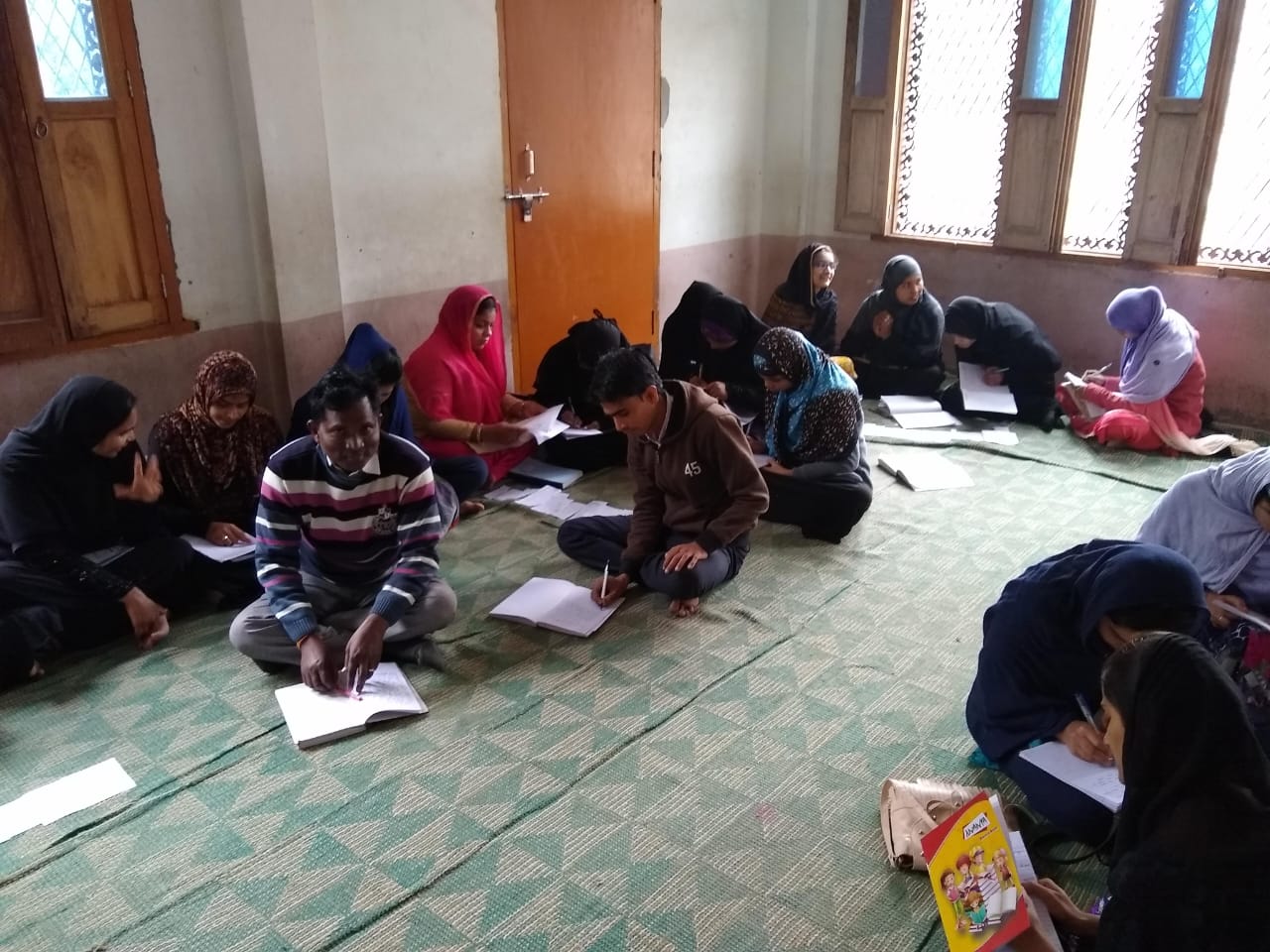 A Classroom for teachers of Madrasa by Tata Trust


