
The Himalayas Are Sending a Warning: A Scientific Call to Assess and Manage Every Ice-Pond and Cryospheric Risk
Subject: Urgent establishment of a transboundary scientific programme for the assessment, monitoring and management of Himalayan ice ponds, glaciers, landslides and flood risks
Excellencies,
I am writing with an urgent appeal following the devastating floods and cryosphere-related events in Nepal and the Nepal–China Himalayan region.
This is not an appeal based on fear. It is an appeal based on science, evidence and the responsibility to prevent avoidable loss of human life.
The Himalayas are undergoing profound environmental change. Nepal, despite contributing less than 0.1% of global greenhouse-gas emissions, remains one of the countries most vulnerable to climate change. Its high-altitude geography, fragile mountain geology, dependence on glacier- and monsoon-fed rivers and climate-sensitive livelihoods create a particularly serious combination of risks.
The recent events in Nepal demonstrate that the world cannot continue to treat Himalayan disasters only after they occur.
We need to move from disaster response to scientific prevention.
I therefore call upon India, China, Nepal, the United Nations and the international scientific community to establish an ambitious, permanent and transparent Himalayan Cryosphere Risk Management Programme, with the scientific assessment and management of every identified ice pond and associated high-risk water body as one of its immediate priorities.
The 46 reported ice-pond sites require a coordinated scientific programme
The material available to us reports 21 ice ponds on the Nepal side and 25 on the China side—46 reported sites in the Nepal–China border region.
I do not suggest that the mere presence of an ice pond means that it represents an imminent disaster. That determination must be made by qualified scientists through field investigation, remote sensing, hydrological modelling and geological assessment.
But precisely because these sites have been identified, none should remain scientifically unknown.
Every site should be mapped, measured, classified and continuously assessed according to its actual characteristics and potential downstream consequences.
The objective must be clear:
No potentially significant Himalayan ice-pond or cryospheric water body should remain without a scientific assessment, a defined risk classification, a monitoring plan and, where necessary, a risk-reduction and emergency-management plan.
A SCIENTIFIC MISSION FOR EVERY SITE
For every identified ice pond, glacial lake or associated cryospheric water body, I propose a common scientific protocol.
1. Identify and map
Each site should be precisely located through satellite imagery, remote sensing and ground verification.
The scientific inventory should record:
- geographic coordinates;
- elevation;
- surface area;
- estimated depth and volume where feasible;
- relationship with glaciers and snowfields;
- surrounding slopes and geological formations;
- downstream drainage routes;
- nearby settlements and infrastructure.
2. Determine its physical stability
Scientists should examine whether the water body is stable or changing and whether it is influenced by:
- glacier retreat;
- snow and ice melt;
- moraine conditions;
- permafrost change;
- slope instability;
- avalanches;
- landslides;
- extreme precipitation;
- river blockage or drainage processes.
The purpose is to distinguish ordinary environmental change from genuine hazard.
3. Measure change over time
A single photograph is not a monitoring system.
Each site should be monitored over time so that scientists can identify changes in:
- water level;
- surface area;
- volume;
- glacier position;
- snow and ice conditions;
- surrounding slopes;
- rainfall and temperature;
- drainage characteristics.
High-risk sites should receive continuous or appropriately frequent monitoring.
4. Classify risk scientifically
Every site should receive a scientifically justified risk classification, such as:
Low — Moderate — High — Critical
The classification should not be political and should not be permanent.
Climate and geological conditions change. Risk classifications must therefore be periodically reviewed.
5. Model the consequences
Where a site presents a significant potential hazard, scientific models should estimate:
- possible breach mechanisms;
- potential flood volume;
- peak discharge;
- flood-wave travel time;
- downstream pathways;
- sediment and debris movement;
- communities potentially exposed;
- roads, bridges, hydropower projects and other critical infrastructure at risk.
This is where modern science can make an enormous difference.
Knowing that a risk exists is important. Knowing where the water could go and how much time communities may have is lifesaving.
FROM MONITORING TO MANAGEMENT
Monitoring alone is not enough.
Where scientific evidence establishes a significant hazard, appropriate risk-reduction measures should be considered.
Depending on the characteristics of each site, these may include:
- controlled or engineered drainage;
- stabilisation of vulnerable retaining structures;
- slope stabilisation;
- protective infrastructure;
- modification of drainage channels;
- strengthening of downstream infrastructure;
- relocation or protection of particularly exposed facilities;
- community evacuation planning;
- installation of automated warning systems.
No engineering intervention should be imposed without site-specific scientific assessment.
The principle must be: science first, intervention where justified, and continuous reassessment.
THE HIMALAYAN RISK IS A CONNECTED SYSTEM
The scientific challenge is larger than individual ice ponds.
The Himalayas represent a connected system involving glaciers, snow, rainfall, rivers, slopes, settlements and infrastructure.
A change in one component can interact with another.
An avalanche may enter a river.
A landslide may block a river.
Water may accumulate behind the blockage.
A sudden breach may produce a destructive flood downstream.
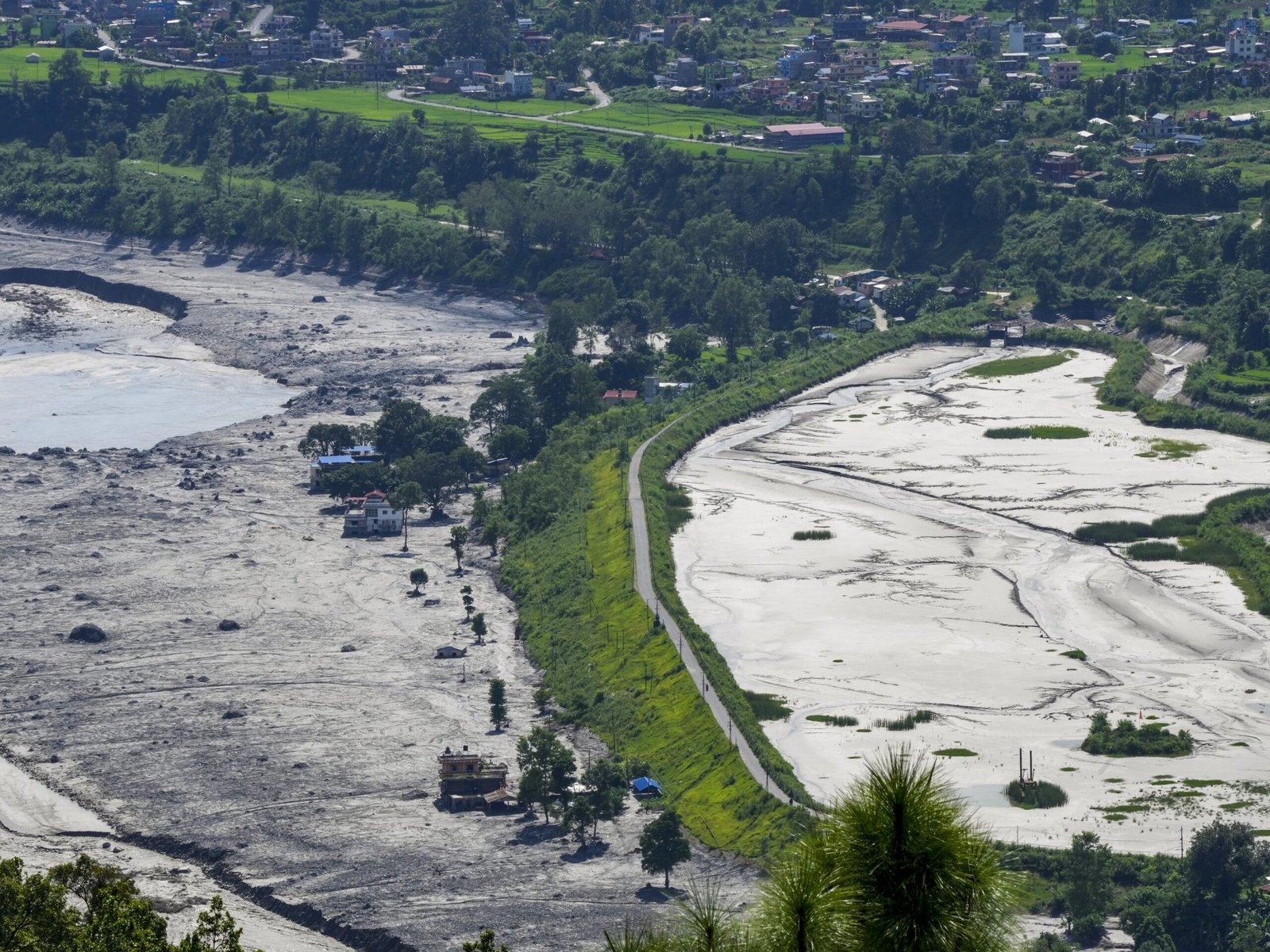
The material concerning the recent Rasuwa event describes an avalanche involving ice and rock entering the Lende Khola River and notes investigation into whether landslide debris temporarily blocked the river and created a landslide dam.
This is precisely why Himalayan disaster management must adopt a compound-hazard approach.
We should no longer examine glaciers, landslides, rainfall and rivers as completely separate phenomena.
They must be studied as an interconnected mountain system.
THE WARNING FROM MELAMCHI
Nepal has already experienced the consequences of interacting climatic and geological hazards.
The June 2021 Melamchi disaster involved intense rainfall, a glacial lake outburst mechanism and a landslide-blocked river. More than 20 people were reported killed, at least 350 residential buildings were swept away, and major water-supply infrastructure was buried under mud and rock.
This experience should not be remembered only as a tragedy.
It should become a scientific lesson.
Every disaster should increase our capacity to prevent the next one.
EARLY WARNING MUST CROSS BORDERS
One of the most important lessons emerging from these events is that scientific information cannot be confined by political boundaries.
The source material reports that during a previous flood originating in Tibet, Nepali officials said that they had not received advance warnings from China and that there was no adequate system for sharing such information. Experts cited in the material emphasise that effective early warning in transboundary river basins requires international cooperation and rapid information-sharing.
This is a matter of practical human security.
If a hazard begins upstream, the downstream population should not have to wait for the disaster itself to discover what has happened.
I therefore call for a permanent India–China–Nepal scientific information-sharing mechanism.
It should establish agreed protocols for the rapid exchange of relevant:
- meteorological observations;
- river-level information;
- hydrological data;
- satellite observations;
- glacier and snow information;
- avalanche observations;
- landslide information;
- glacial-lake and ice-pond changes;
- emergency warnings.
Where information has direct implications for human safety, speed must be treated as part of scientific responsibility.
ESTABLISH A HIMALAYAN CRYOSPHERE OBSERVATORY
I propose the creation of a:
Himalayan Transboundary Cryosphere and Hydrological Risk Observatory
This should be a collaborative scientific platform involving Nepal, China, India and relevant international institutions.
It should integrate:
Satellite observation + ground monitoring + hydrology + glaciology + geology + meteorology + climate science + disaster-risk reduction + community knowledge.
The Observatory should maintain a scientifically governed inventory of:
- glaciers;
- glacial lakes;
- reported ice ponds;
- avalanche-prone areas;
- landslide-prone slopes;
- landslide dams;
- vulnerable river corridors;
- downstream settlements;
- critical infrastructure.
It should also establish common standards for measuring and classifying risk.
SCIENCE MUST REACH THE LAST VILLAGE
A sophisticated scientific observatory will have limited value if its warnings do not reach the people living downstream.
Every high-risk community should have access to:
- understandable warning messages;
- local warning systems;
- evacuation routes;
- designated safe locations;
- emergency communication;
- trained local response teams;
- regular evacuation exercises;
- special arrangements for children, older persons and persons with disabilities.
Communities should not be treated merely as recipients of warnings.
They should be participants in the scientific risk-management system.
Local knowledge about rivers, slopes, springs, seasonal changes and previous disasters should be combined with modern scientific observation.
INDIA AND CHINA: TURN THE HIMALAYAS INTO A REGION OF SCIENTIFIC COOPERATION
India and China possess enormous scientific and technological capabilities.
They also share responsibility for a mountain system whose environmental changes have consequences far beyond their own territories.
Political differences should not prevent cooperation where human life is at stake.
A glacier does not recognise a political boundary.
A landslide does not carry a passport.
A river does not stop flowing because an international border has been crossed.
A flood wave cannot be stopped by diplomatic disagreement.
I therefore appeal particularly to the leadership of India and China:
Create a scientific channel that remains open even when political channels become difficult.
Let Himalayan scientific cooperation become an example to the world.
THE UNITED NATIONS MUST HELP BUILD THE FRAMEWORK
I respectfully call upon the United Nations to convene a Himalayan Scientific and Humanitarian Risk Conference involving:
- Nepal;
- India;
- China;
- Bhutan;
- relevant downstream countries;
- ICIMOD;
- WMO;
- UNESCO;
- UNEP;
- UNDRR;
- UNDP;
- universities and research institutions;
- glaciologists;
- hydrologists;
- geologists;
- climate scientists;
- disaster-management specialists;
- representatives of Himalayan communities.
The outcome should not be another symbolic declaration.
It should produce a time-bound scientific action plan.
The world knows enough to begin.
CLIMATE JUSTICE REQUIRES SCIENTIFIC INVESTMENT
Nepal’s vulnerability presents a fundamental climate-justice question.
The country contributes only a tiny fraction of global emissions, yet its geography exposes its people to disproportionate climate risks.
More than 80% of Nepali farmers are reported in the source material to depend on rain-fed subsistence agriculture, while water, agriculture and hydropower are strongly connected to glacier and monsoon systems.
Therefore, international climate finance should support not only emissions reduction, but adaptation and scientific risk prevention.
Investment is urgently required for:
- cryosphere research;
- satellite monitoring;
- ground-based monitoring;
- early-warning infrastructure;
- hydrological modelling;
- resilient infrastructure;
- community preparedness;
- climate-resilient agriculture;
- emergency response;
- rehabilitation and recovery.
Preventing a disaster is more humane—and ultimately more rational—than rebuilding after every disaster.
A FIVE-POINT GLOBAL SCIENTIFIC COMMITMENT
I respectfully ask the leaders addressed in this letter to support five immediate commitments:
1. ASSESS EVERY SITE
Scientifically identify and assess every reported ice pond, glacial lake and potentially hazardous cryospheric water body.
2. MANAGE THE RISK
Where scientific evidence establishes significant danger, develop and implement appropriate risk-reduction measures.
3. CONNECT THE REGION
Establish a permanent transboundary mechanism for scientific data and emergency information-sharing between Nepal, China and India.
4. WARN COMMUNITIES
Ensure that high-risk communities receive timely, understandable and actionable warnings.
5. FINANCE SCIENCE AND RESILIENCE
Establish international financing for Himalayan scientific monitoring, climate adaptation and community-led disaster preparedness.
THIS IS A HUMAN RIGHTS ISSUE
Climate disasters are often described in terms of infrastructure and economic loss.
But the first question must always be:
How many human lives can we protect?
A family losing its home is not merely an economic statistic.
A missing person is not merely a number in a disaster report.
A destroyed village represents generations of human memory, culture and livelihood.
Climate change therefore has a direct relationship with the rights to life, livelihood, food, water, health, housing and dignity.
Scientific knowledge should serve those rights.
AN APPEAL FOR A NEW HIMALAYAN ETHIC
The world has invested enormously in understanding the climate system.
Now we must invest with equal determination in protecting the people who are most exposed to its consequences.
The Himalayas are not simply a spectacular mountain landscape.
They are a living ecological and hydrological system upon which millions of people depend.
The reported 46 ice-pond sites should therefore be understood as part of a much larger scientific question: how can humanity responsibly manage rapidly changing mountain environments before hazards become catastrophes?
We must not wait for another valley to disappear beneath mud and water.
We must not wait for another family to search for missing loved ones.
We must not wait for another disaster before exchanging information that could have been shared earlier.
The time for scientific cooperation is before the flood, not after it.
I therefore urge the leaders of India, China, Nepal and the United Nations to make the Himalayan cryosphere a permanent priority of international scientific cooperation.
Let us establish the observatory.
Let us assess every site.
Let us manage every scientifically identified risk.
Let us connect the warning systems.
Let us empower mountain communities.
Let us finance adaptation.
Let us make science accessible to those whose lives depend upon it.
The Himalayas are changing.
Our cooperation must change faster.
The choice before us is not between development and science, nor between sovereignty and cooperation.
It is between preparedness and preventable loss of life.
I believe the world’s major powers, Himalayan governments, scientists and international institutions have the knowledge and capacity to choose preparedness.
Let us do so now.
From India, I stand in solidarity with the people of Nepal and with all Himalayan communities facing this unprecedented environmental challenge.
Human dignity knows no borders.
Sincerely,


.jpeg)
.jpeg)


.jpeg)


